What Happens If Your DLP Expires Without an Inspection?
Every month, thousands of Dubai homeowners lose their right to free property repairs. Not because the developer refused to fix anything. Not because there were no defects. But because the homeowner let their Defect Liability Period expire without getting a professional inspection.
When your DLP expires, the developer’s obligation to fix construction defects in Dubai ends. Permanently. There is no extension, no grace period, and no second chance. Every repair that was free yesterday becomes your bill today.
If your DLP is expiring in the next few months, this article is for you.
A Quick Reminder: What Is the DLP?
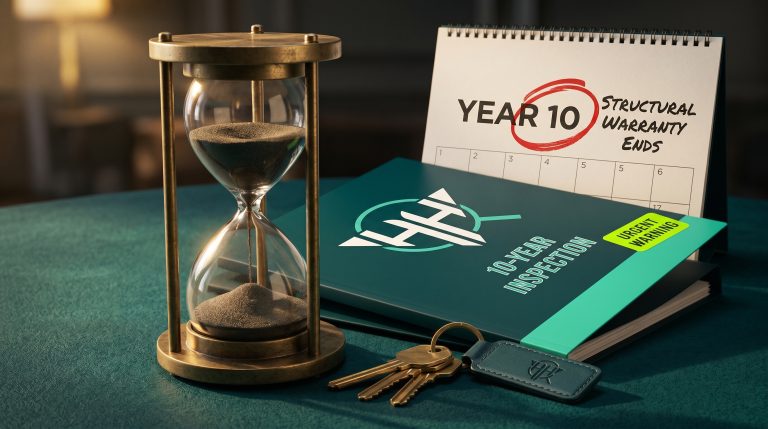
The Defect Liability Period (DLP) is a fixed window after handover during which the developer must fix qualifying construction defects at their own expense. Under UAE Law No. 6 of 2019, this means 1 year for mechanical, electrical, plumbing, and finishing defects, and 10 years for structural defects.
During this window, the developer is legally required to repair issues like faulty wiring, plumbing leaks, AC problems, hollow tiles, paint defects, and anything else that resulted from construction quality rather than normal use.
For a full breakdown of what the DLP covers and how it works, read our complete Defect Liability Period guide.
What Happens the Day After Your DLP Expires
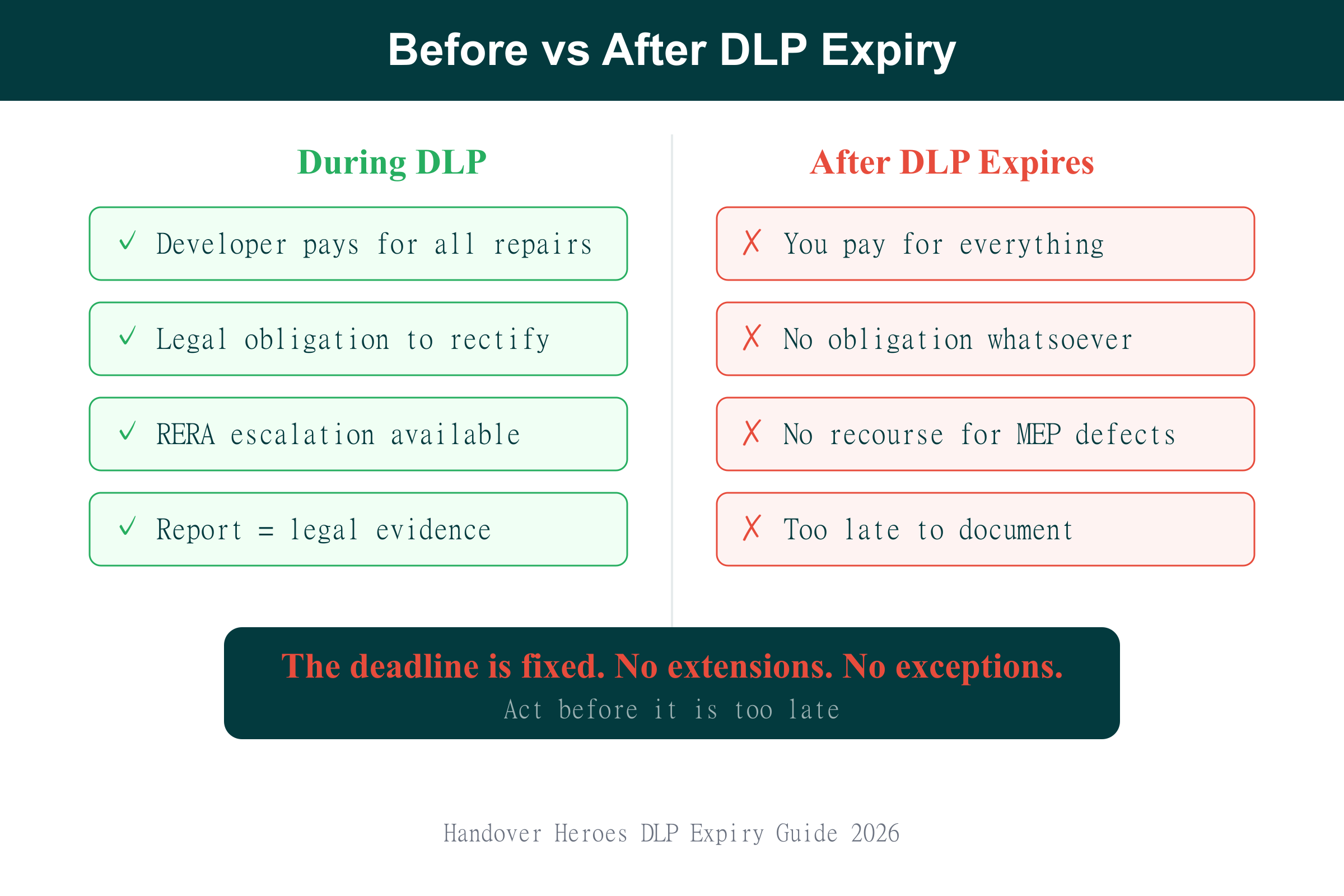
The answer is straightforward and absolute: the developer is no longer obligated to fix anything.
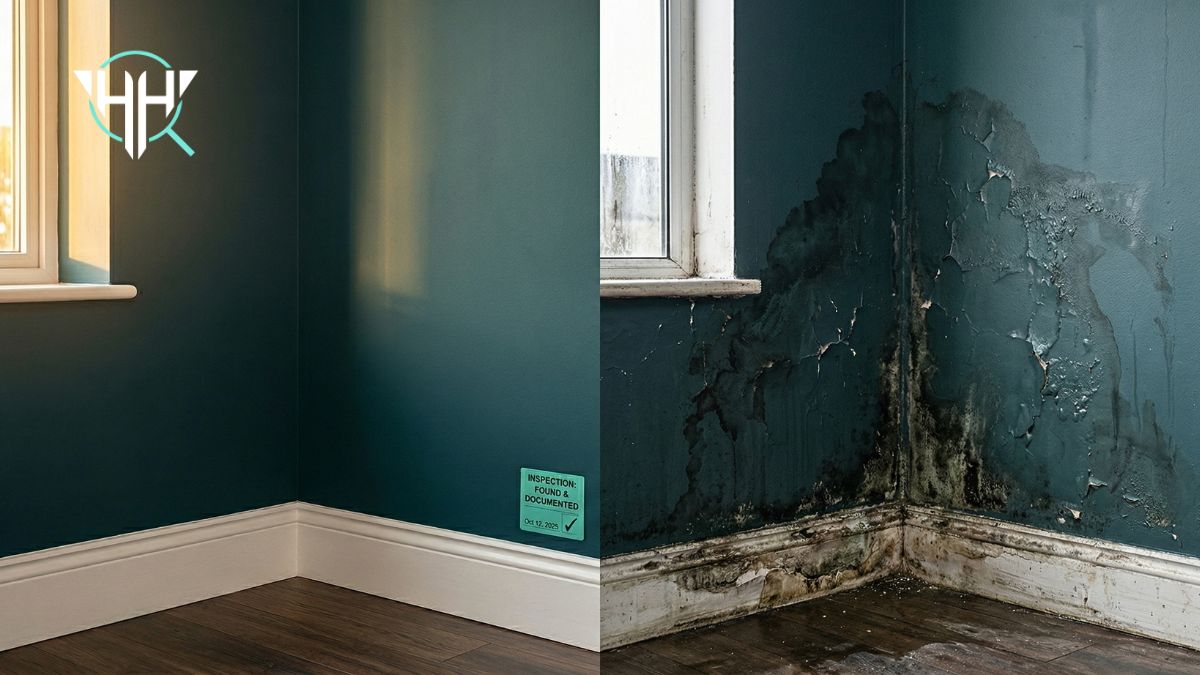
That leaking pipe behind your bathroom wall? Your problem. The AC unit that never cooled the master bedroom properly? Your cost. The 15 hollow tiles in the kitchen that you kept meaning to report? Your expense.
There are no exceptions. There are no extensions. There is no process to appeal the expiry date. The DLP is a fixed deadline, and once it passes, the financial responsibility for every defect shifts entirely from the developer to you.
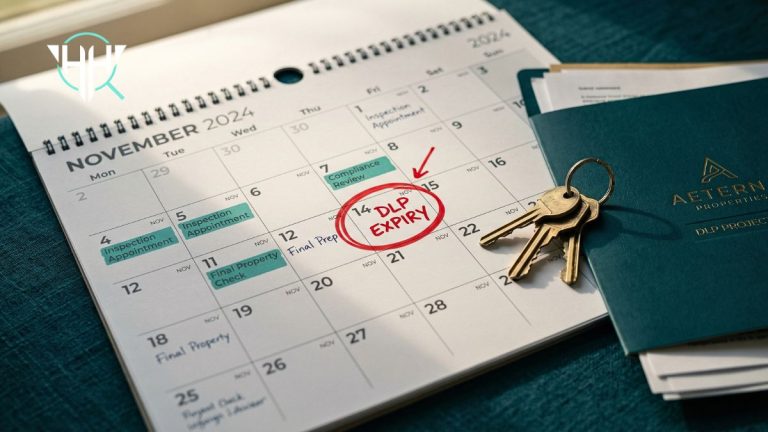
It is also important to understand that the DLP expiry date is based on the building completion certificate, not the date you collected your keys. In many cases, the completion certificate was issued weeks or months before individual unit handovers began. This means your 1-year window may have already been shrinking from a date you were not even aware of.
Real Cost Examples: What Dubai Homeowners Pay After DLP Expiry
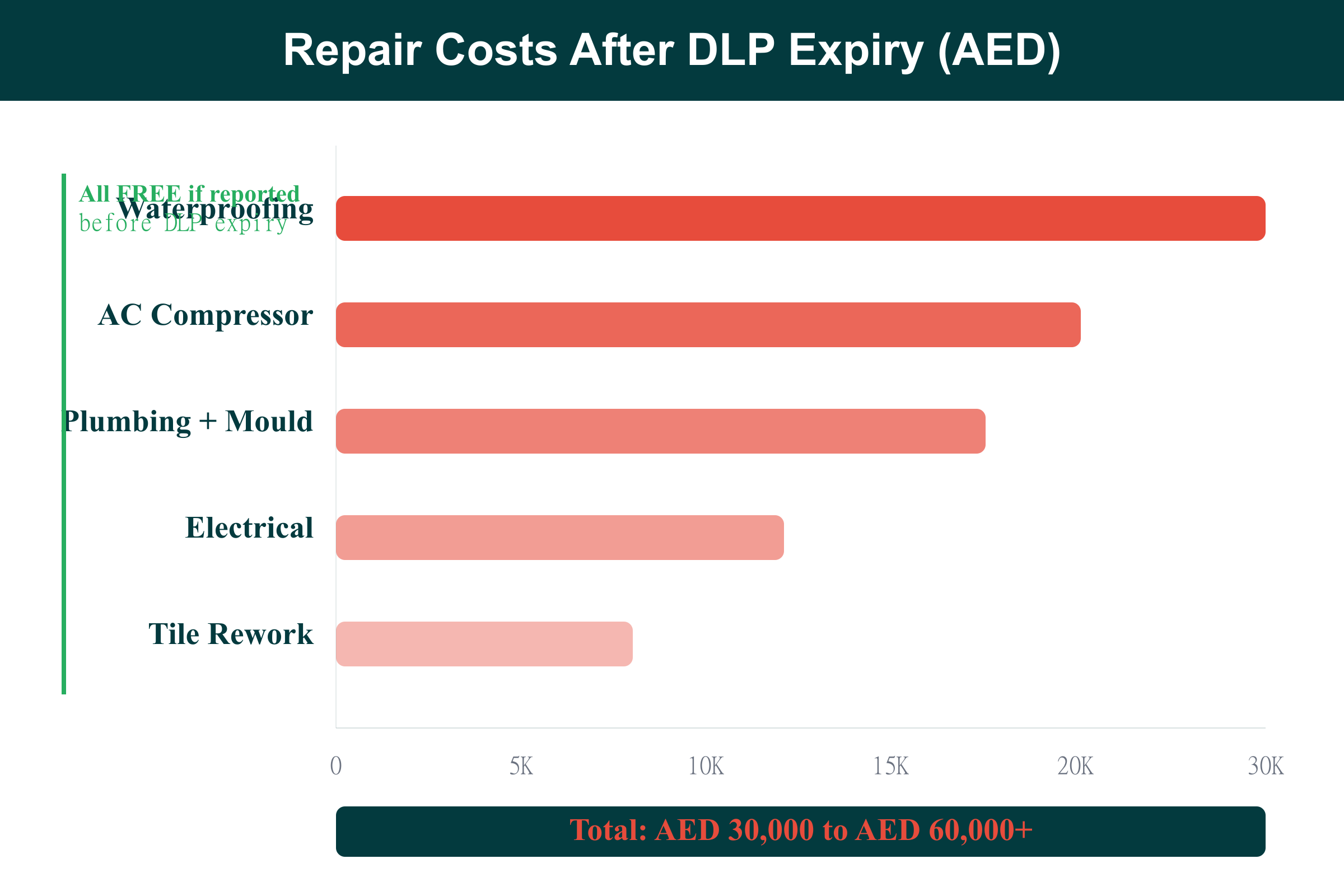
These are typical repair costs for defects that would have been fixed for free if reported during the DLP:
- Plumbing leak behind a bathroom wall: AED 8,000 to AED 15,000. This includes locating the leak, opening the wall, repairing the pipe, waterproofing the area, re-tiling, and repainting. If mould has developed from prolonged exposure, add AED 3,000 to AED 8,000 for remediation.
- Full AC compressor replacement: AED 10,000 to AED 20,000. Compressors that were improperly commissioned during construction degrade faster and fail earlier. If the issue had been identified during a DLP inspection, the developer would have recalibrated or replaced the unit at no cost.
- Waterproofing failure on a balcony or terrace: AED 15,000 to AED 30,000. This requires stripping the existing tiles and membrane, re-waterproofing the surface, and re-tiling. Balcony waterproofing failures also cause damage to the unit below, which can create liability disputes with neighbours.
- Electrical rewiring for safety compliance: AED 5,000 to AED 12,000. Reversed polarity, missing grounding, and undersized circuit breakers are installation defects that should have been caught during construction. After the DLP expires, correcting these requires an electrician, wall access, and potentially new cabling.
- Hollow tile replacement across kitchen and bathrooms: AED 3,000 to AED 8,000. Each hollow tile needs to be carefully removed, the substrate cleaned and re-prepared, new adhesive applied, and the tile relaid. Matching the original tile colour and pattern is often difficult, adding cost and visual compromise.
Total potential exposure if multiple defects exist: AED 30,000 to AED 60,000 or more. All of it free if documented and reported before the DLP expired. For context on what inspections cost, see our guide to property snagging cost in Dubai.
Why Most Homeowners Miss Their DLP Window in Dubai
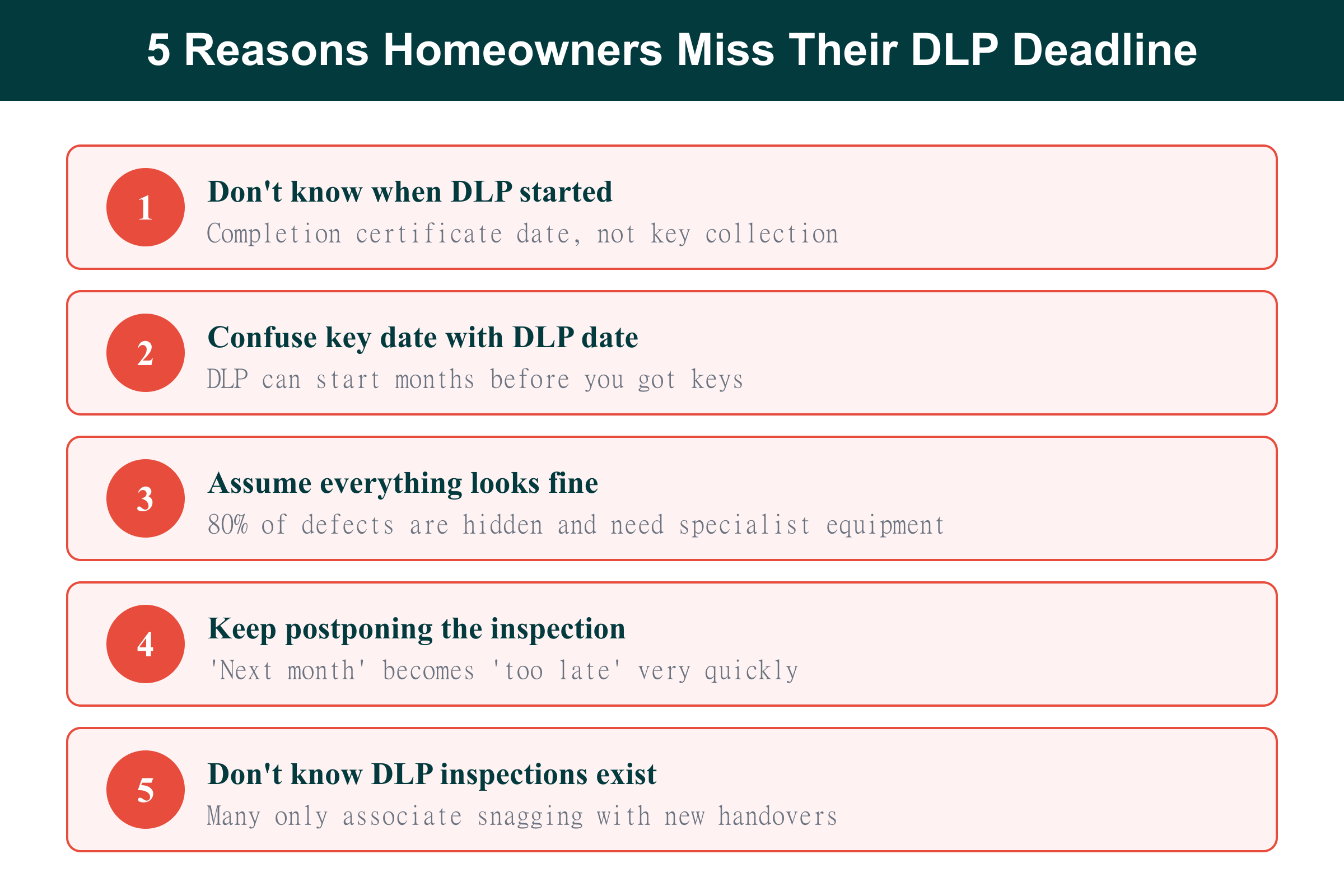
Understanding why people miss the deadline is just as important as understanding what happens when they do. These are the five most common reasons:
They do not know when their DLP started. Many homeowners assume the DLP starts on the day they received their keys. In reality, it often starts from the building completion certificate date, which can be weeks or months earlier. Without checking, they calculate the wrong expiry date and miss the window.
They confuse the key collection date with the DLP start date. This is a specific version of the above, and it catches a huge number of homeowners. If your building completion certificate was issued in January and you collected your keys in April, your 1-year DLP for MEP and finishing expires in January of the following year, not April.
They assume everything looks fine. A property that looks clean and new on the surface can have dozens of hidden defects. Hollow tiles look identical to properly bonded tiles. Reversed polarity sockets look and function normally until they damage an appliance. Hidden moisture behind walls is completely invisible without thermal imaging. The fact that everything “looks fine” is exactly why professional inspections exist. For more on this, see our guide to common defects in Dubai properties.
They plan to do it later and forget. Life is busy. Moving into a new home involves furniture, DEWA registration, internet setup, and a hundred other tasks. The DLP inspection keeps getting pushed to “next month” until suddenly the expiry is a week away and it is too late to get the developer to complete repairs in time.
They do not know DLP inspections exist. Many homeowners simply do not know that a DLP inspection is a service they can book. They associate snagging with new handovers only and do not realise that a separate inspection specifically designed for the DLP window is available and essential.
What You Should Do Right Now If Your DLP Is Expiring Soon
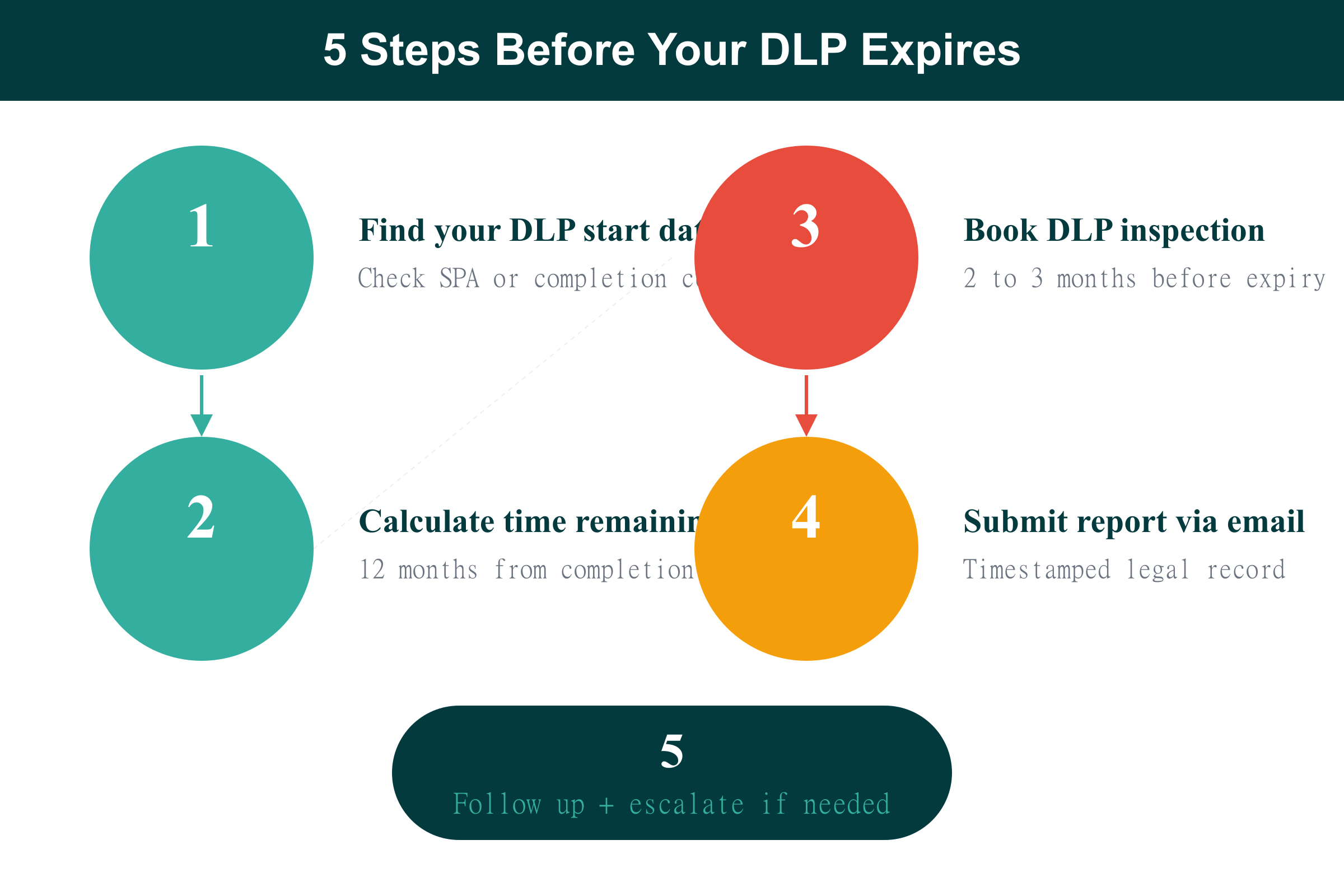
If your DLP expiry is approaching within the next 3 months, take these steps immediately:
Step 1: Find your actual DLP start date. Check your Sales and Purchase Agreement (SPA), your handover notice, or contact the developer directly to confirm the building completion certificate date. This is your real start date, not the day you collected keys.
Step 2: Calculate how much time you have left. Count forward 12 months from the completion certificate date for MEP and finishing coverage. If you are within 3 months of that date, act now.
Step 3: Book a professional DLP inspection. A DLP inspection is specifically designed to catch every defect before your warranty expires. It covers a full re-assessment of all property systems, identifies defects that have developed since handover, and verifies whether any previously reported defects were actually fixed by the developer. For a full list of what inspectors check, see our snagging checklist.
Step 4: Submit the inspection report to the developer in writing. Email the report to Emaar, DAMAC, Sobha, or whichever developer built your property. A formal email with the inspection report attached creates a legal record that you reported the defects within the DLP window. This is critical.
Step 5: Follow up and escalate if needed. If the developer does not respond or delays repairs, follow up in writing every 7 to 14 days. If they refuse to act, file a complaint with RERA through the Dubai REST app, escalate to the Dubai Land Department, or consult a legal professional. Your inspection report and email correspondence are your evidence at every stage.
What If Your DLP Has Already Expired?
If your 1-year MEP and finishing DLP has already passed, your options are more limited, but not zero.
Structural defects may still be covered. Under UAE Law No. 6 of 2019, developers are responsible for structural defects for up to 10 years from the building completion certificate. If you suspect a structural issue (major cracking, foundation problems, waterproofing failures in the building envelope), this may still fall within the developer’s obligation.
For MEP and finishing defects, you will likely need to pay for repairs yourself. The developer is no longer obligated to fix non-structural defects after the 1-year window closes. However, a property inspection can still help you prioritise which repairs are urgent (safety and water damage), which can wait, and what each repair will cost so you can budget accurately.
If you plan to sell your property, an inspection report adds transparency and buyer confidence. A documented condition assessment shows potential buyers exactly what state the property is in, which can actually strengthen your negotiating position and speed up the sale.
For more detail on common defects and their repair costs, see our dedicated guide.
How a DLP Inspection Protects You Before Expiry
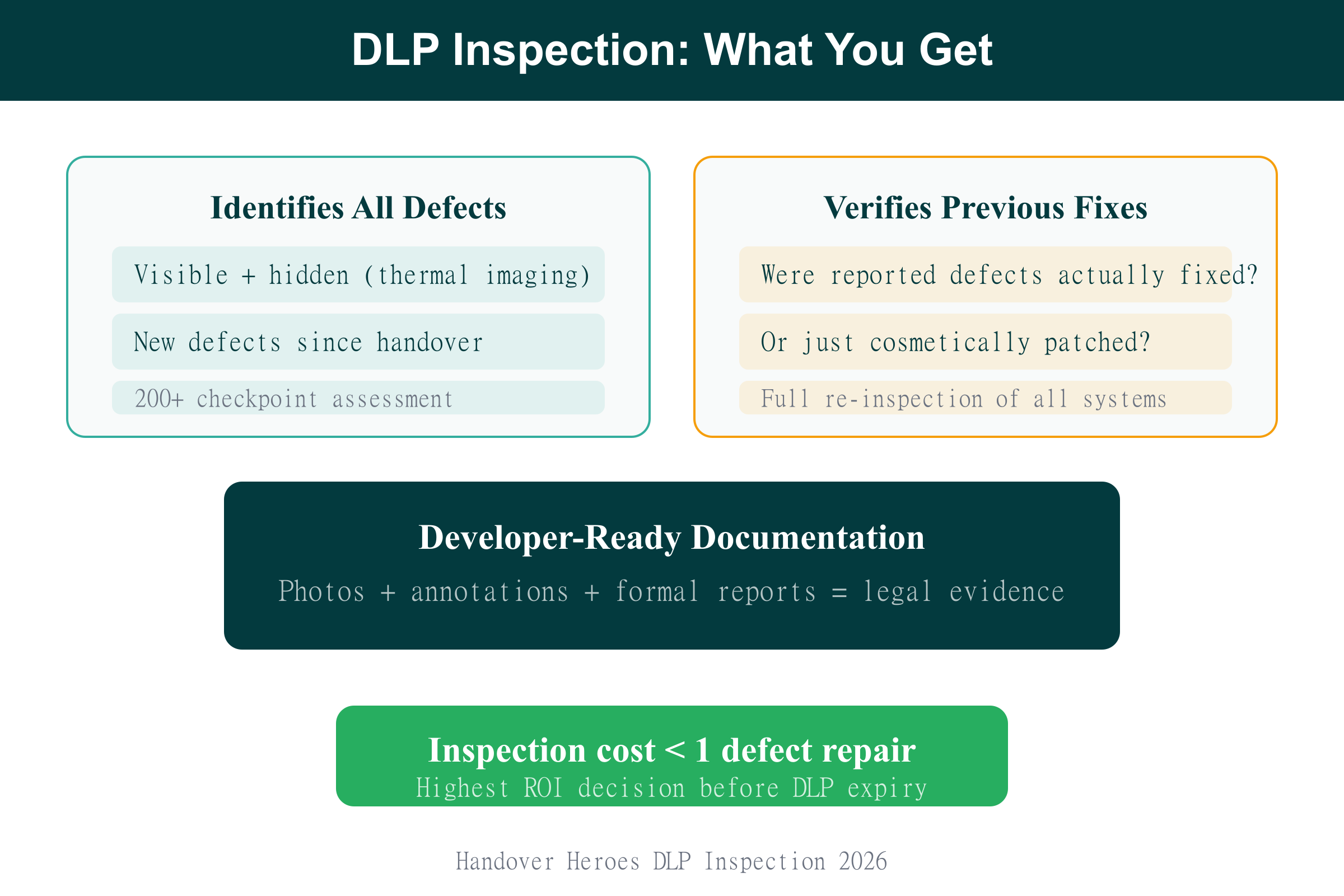
A DLP inspection is your last line of defence before the developer’s warranty expires. It identifies all current defects in the property, both visible and hidden. It verifies whether defects you previously reported to the developer were actually fixed properly or just cosmetically patched. It documents everything in a developer-ready format with photographs and annotations. And it gives you a formal legal record that you can use if RERA escalation becomes necessary.
The inspection costs a fraction of what a single undetected defect would cost to repair after the DLP expires. It is the highest-ROI decision you can make as a homeowner in the final months of your warranty.
Learn more about our DLP inspection service or book now on WhatsApp.
Frequently Asked Questions About DLP Expiry in Dubai
Can I get an extension on my DLP?
No. The Defect Liability Period is a fixed legal deadline. There are no extensions, grace periods, or exceptions. Once the 1-year MEP and finishing window passes, the developer’s obligation to repair non-structural defects ends permanently. The only way to protect yourself is to book a DLP inspection and submit your defect report before the deadline.
What if I reported defects but the developer has not fixed them by the time my DLP expires?
If you reported defects in writing during the DLP window and the developer has not completed repairs, they are still obligated to fix them. The key is having documented proof (email with report attached) that you reported the defects before expiry. Keep following up in writing and escalate to RERA if necessary.
How far in advance should I book a DLP inspection?
Book your DLP inspection 2 to 3 months before the expiry date. This gives enough time for the inspection, report delivery within 24 hours, developer submission, and the developer to schedule and complete repairs before the warranty window closes. Booking too late leaves no time for rectification.
Does the 10-year structural warranty really apply?
Yes. Under UAE Law No. 6 of 2019, developers are responsible for structural defects (foundation, load-bearing walls, columns, slabs) for 10 years from the building completion certificate date. This is separate from the 1-year MEP warranty. If you suspect a structural defect after year one, consult a professional and consider legal advice.
Your Free Repairs Are Expiring
Every day that passes without a DLP inspection is a day closer to paying out of pocket for defects the developer would have fixed for free. Do not be one of the thousands of Dubai homeowners who miss this deadline.
Book your DLP inspection with Handover Heroes today. We identify every defect, document it in a developer-ready report, and support you through the entire rectification process until every issue is resolved.