Dubai vs Abu Dhabi Snagging: How Property Inspection Differs Across the UAE
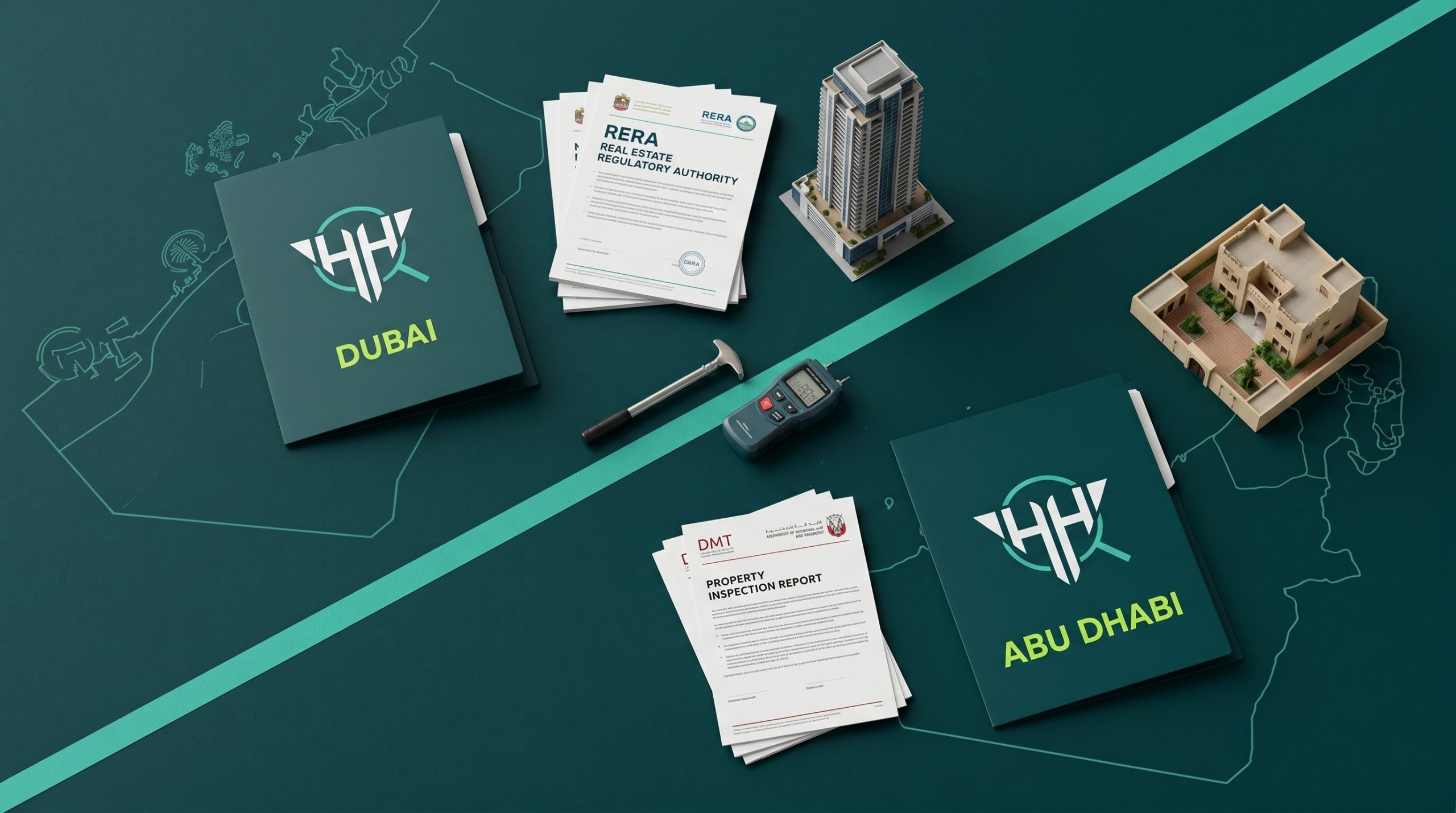
Dubai vs Abu Dhabi snagging is the most common comparison UAE property buyers ask us about, because the two emirates operate under different regulators, developer ecosystems, and defect patterns even though they share the same UAE warranty law.
Dubai vs Abu Dhabi snagging in 2026 follows the same 200+ checkpoint inspection logic, but the reporting format, escalation route, and common defect mix differ in ways every buyer should understand before signing handover documents. This guide breaks down what changes between the two emirates, what stays the same, and how to choose an inspection partner that works in both.
The Regulatory Framework Behind Dubai vs Abu Dhabi Snagging
Dubai
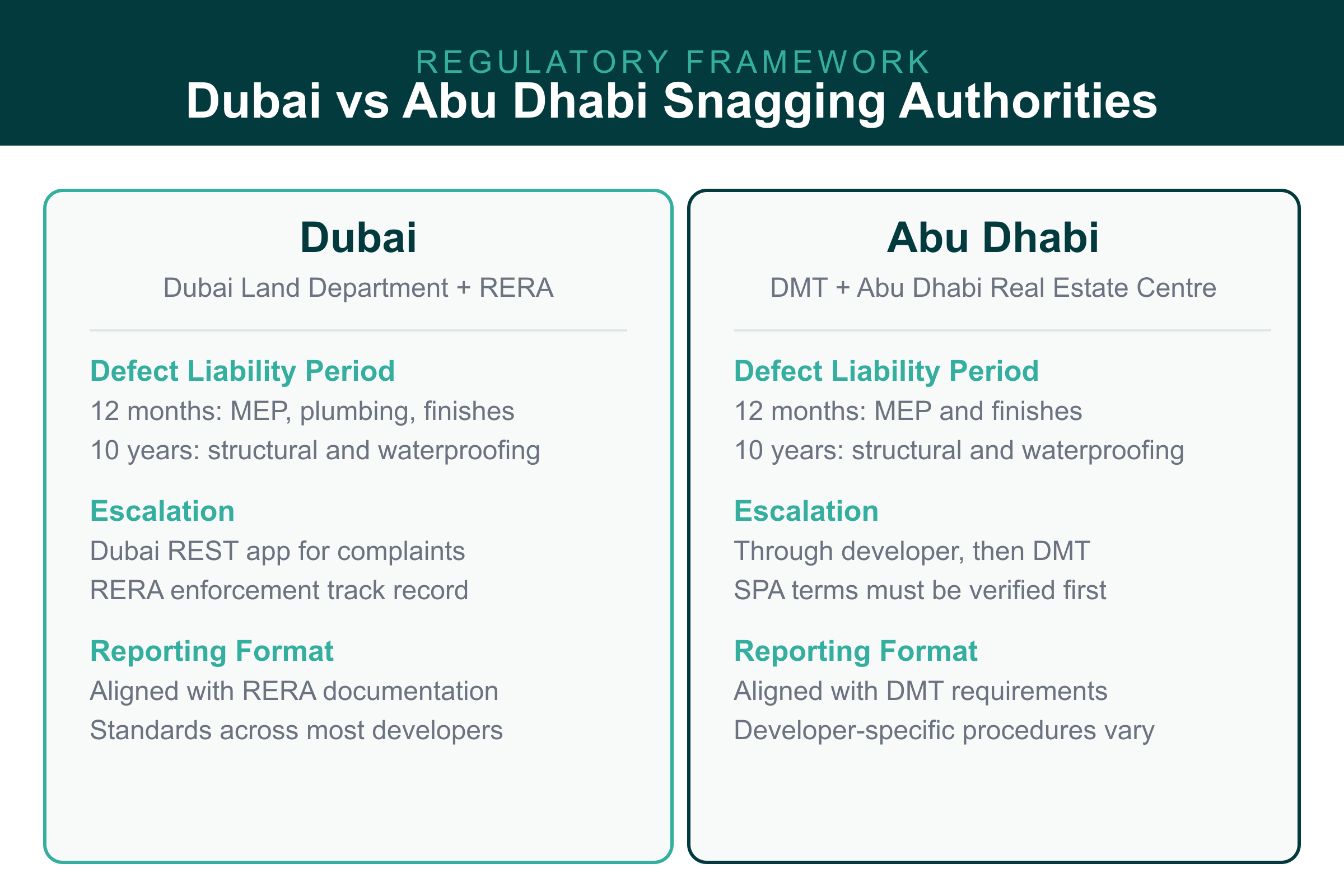
Property transactions and developer obligations in Dubai are regulated by the Dubai Land Department (DLD) and the Real Estate Regulatory Agency (RERA). Under UAE Law No. 6 of 2019 and RERA regulations, developers must provide a 12-month Defect Liability Period for mechanical, electrical, plumbing, and finishing defects, plus a 10-year structural warranty covering load-bearing elements, waterproofing, and foundation integrity.
If a developer refuses to rectify documented defects, buyers can file a complaint through the Dubai REST app. RERA has a clear complaints process and a track record of enforcing developer obligations.
Abu Dhabi
Property transactions in Abu Dhabi are regulated by the Department of Municipalities and Transport (DMT) and the Abu Dhabi Real Estate Centre. Developer obligations follow similar principles to Dubai, with a one-year warranty covering MEP and finishing defects and a ten-year structural warranty.
However, the specifics of warranty commencement, claim procedures, and escalation paths can differ. Because Abu Dhabi’s framework operates through DMT rather than RERA, some developers apply slightly different documentation standards. This is the most important practical detail in any Dubai vs Abu Dhabi snagging comparison.
What This Means for Buyers
The practical implication is that the inspection report and formal submission process matter equally in both emirates, but the escalation paths differ if a developer becomes uncooperative. A professional inspection with a developer-formatted defect report gives you leverage in either market.
Construction and Developer Ecosystem Differences
Dubai and Abu Dhabi have different developer landscapes, and this directly shapes the Dubai vs Abu Dhabi snagging defect patterns we see in each market.
Dubai
Dubai’s off-plan market is the most active in the UAE, with dozens of major developers completing projects every month. The high volume and fast pace of Dubai construction means more project variety, from affordable apartments in JVC and Town Square to luxury villas in Palm Jumeirah and Emirates Hills.
More frequent handovers mean more buyer demand for snagging services and more established inspection protocols. There is also a wider range of construction quality depending on developer, with some consistently high-quality builders and others with known quality control issues. The most common Dubai defect categories we find are AC commissioning failures, hollow tiles, plumbing leaks, paint and finishing defects, and electrical polarity issues.
Abu Dhabi
Abu Dhabi’s property market is more concentrated, with a smaller number of major developers delivering larger-scale projects. This concentration means longer build cycles and more standardised delivery processes, fewer but larger handover events often delivering hundreds of units simultaneously, and different common defect patterns with more focus on MEP systems and less on finishing inconsistencies.
In Abu Dhabi, we often see more issues with AC commissioning in large residential towers, waterproofing in villa communities (particularly on Yas Island and Saadiyat Island), and electrical system coordination in smart home installations.
Common Defects: Dubai vs Abu Dhabi Snagging Patterns
Dubai Defect Patterns
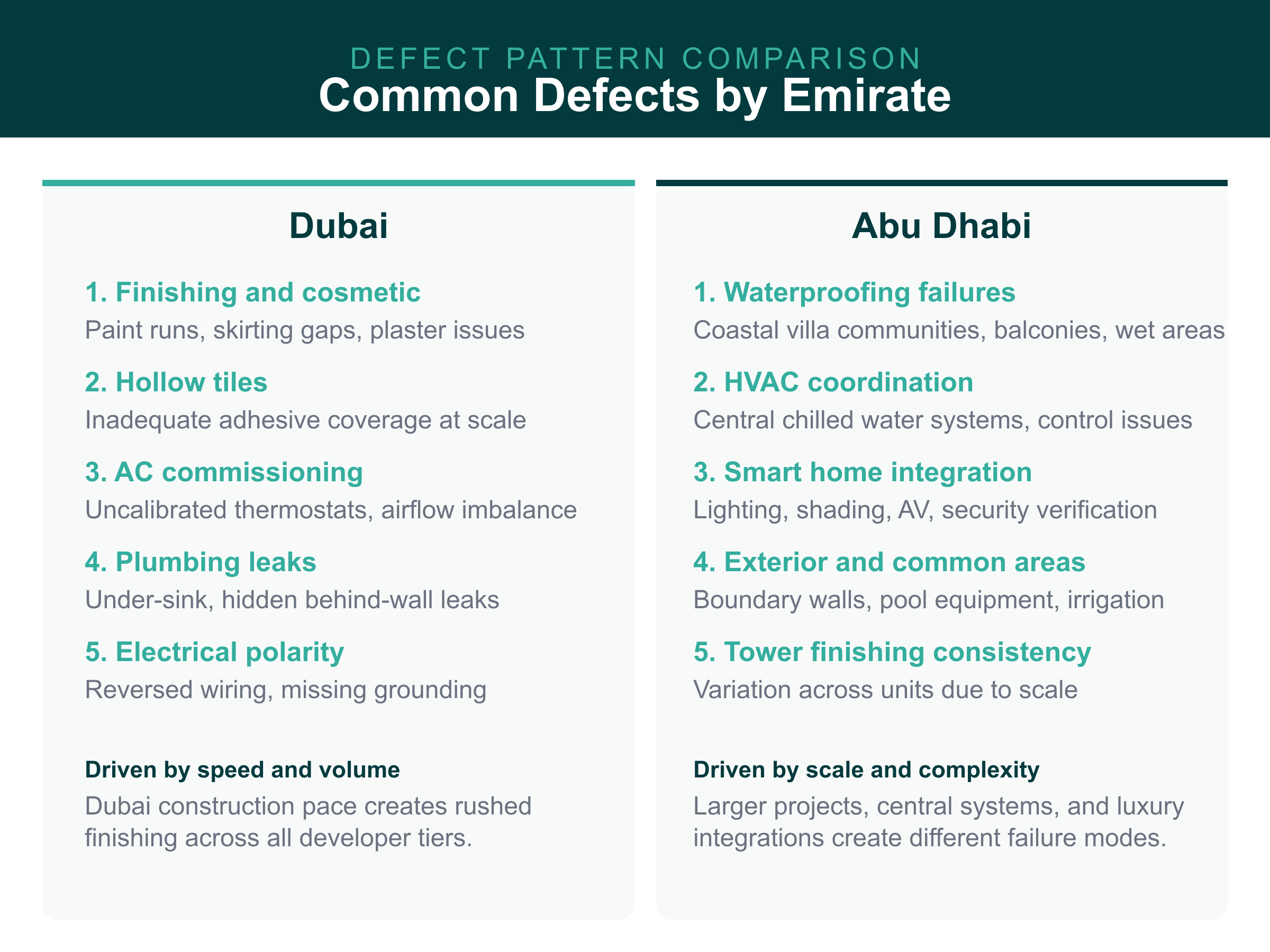
Finishing and cosmetic defects. Paint runs, uneven patches, skirting gaps, and rough plaster are the most common defects in Dubai properties across all developers. The speed of construction contributes to rushed finishing work.
Hollow tiles. Dubai’s tiling installation teams work at scale and speed, which sometimes results in inadequate adhesive coverage. Tap testing consistently reveals hollow tiles across kitchens, bathrooms, and common areas.
AC commissioning failures. Dubai apartments frequently show AC systems that were installed but never properly commissioned. Thermostats are uncalibrated, airflow is unbalanced across rooms, and condensate drainage is sometimes incomplete.
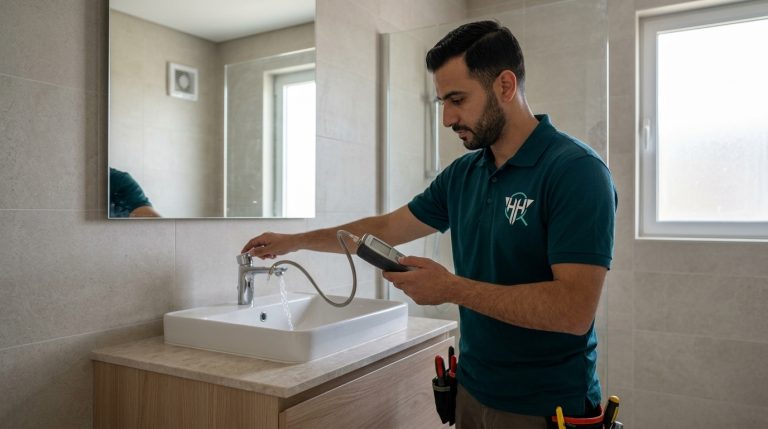
Plumbing leaks and pressure issues. Under-sink leaks, slow drainage, and water pressure inconsistencies are common. Hidden leaks behind walls are the most costly and only detectable with thermal imaging.
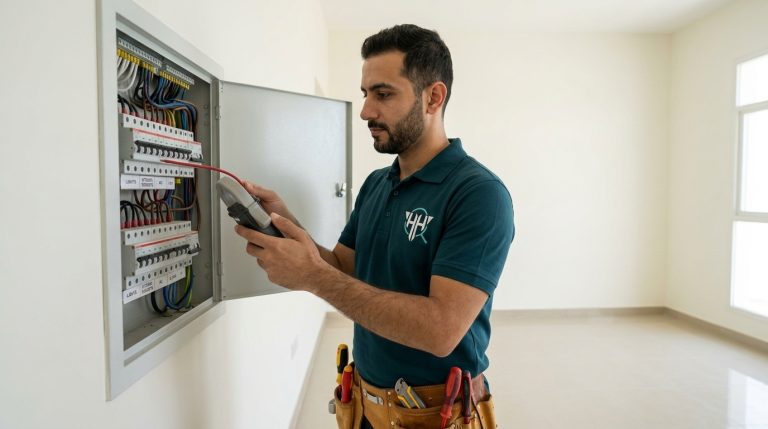
Electrical polarity issues. Reversed wiring in sockets occurs frequently and is invisible without a tester. Every socket in a Dubai apartment should be polarity tested.
Abu Dhabi Defect Patterns
Waterproofing failures. Abu Dhabi’s villa communities on Yas Island, Saadiyat Island, and Reem Island often show waterproofing issues in balconies, terraces, and wet areas. The coastal location accelerates waterproofing wear.
HVAC system coordination. Abu Dhabi’s larger developments often use central chilled water systems rather than split AC units. These have different failure modes, including coordination issues between central systems and individual unit controls.
Smart home system integration. Abu Dhabi’s luxury developments frequently include smart home systems that require technical verification beyond standard snagging. Lighting controls, shading, security integrations, and centralised audio-video all need to be tested.
Exterior and common area defects. Abu Dhabi villa projects have more extensive exterior inspection requirements: boundary walls, landscaping, driveways, pool equipment, and garden irrigation all need to be checked.
Finishing defects in large towers. Paint, joinery, and finishing work in Abu Dhabi’s high-rise residential towers sometimes shows consistency issues across units due to the scale of work.
How Inspections Themselves Differ Between Emirates
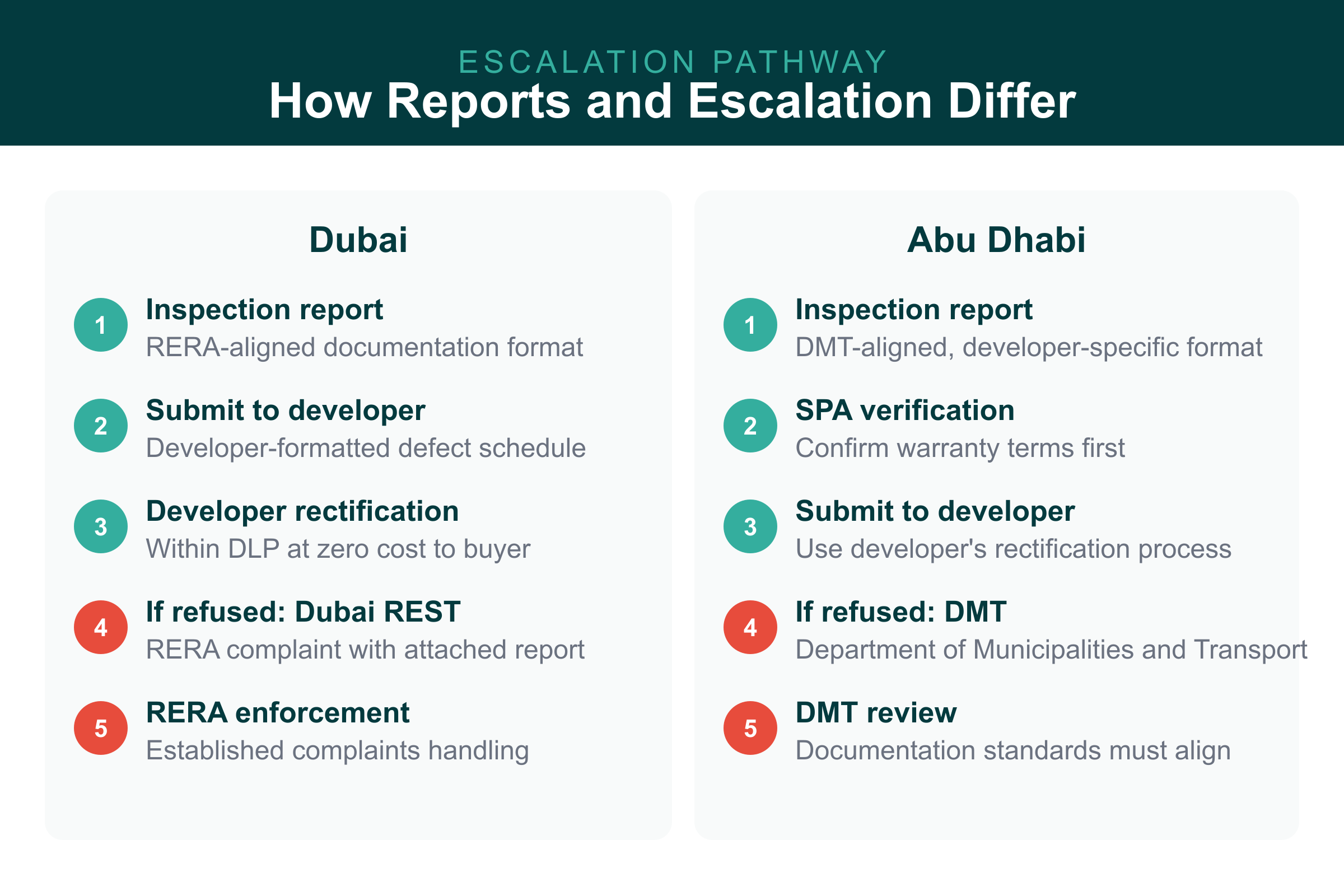
The core inspection checklist is essentially the same in Dubai vs Abu Dhabi snagging. Every property, regardless of emirate, should be inspected for the same 200+ checkpoints covering structural, electrical, plumbing, HVAC, tiling, and finishing categories. For a detailed breakdown, read our complete guide to pre-handover inspections in the UAE.
What differs is the reporting format and the escalation process. In Dubai, inspection reports are typically formatted to align with RERA’s documentation standards. If the developer refuses to rectify defects, the report can be attached to a formal complaint via the Dubai REST app.
In Abu Dhabi, reports should reference DMT requirements and align with the developer’s specific rectification procedures. Escalation typically goes through the developer first, then through DMT if needed. Professional snagging companies operating across the UAE maintain documentation standards that satisfy both authorities, which is essential for any meaningful Dubai vs Abu Dhabi snagging engagement.
Which Emirate Has More Defects on Average?
This is a frequent question and the honest answer is that neither emirate has consistently more defects than the other. Defect rates are driven by developer quality control, construction pace, and project complexity rather than by emirate.
What we do see is that different developers have different average defect counts. Premium developers with strong quality control deliver properties with 30 to 50 defects on average. Mid-tier developers average 50 to 100. Developers with known quality issues can exceed 150 defects per property. For real-world examples, see our breakdown of common defects in Dubai property.
A 2-bedroom apartment in Dubai Hills and a 2-bedroom apartment in Al Raha Beach may have entirely different defect profiles even though they are similar properties in different emirates. What matters is the developer, not the location.
Do You Need Different Snagging Services for Each Emirate?
If you are buying in Dubai, Abu Dhabi, Sharjah, or Ras Al Khaimah, you want a snagging company that understands the regulatory environment in each emirate and can produce reports that work across all of them. At Handover Heroes, our pre-handover inspection service uses the same rigorous standards regardless of emirate, and our reports are formatted to satisfy RERA, DMT, and all major developers.
This matters because many UAE investors own properties across multiple emirates. Having one inspection partner with consistent standards simplifies the process significantly, particularly for buyers comparing Dubai vs Abu Dhabi snagging providers.
For buyers also considering DLP coverage, see our complete guide to the Defect Liability Period in Dubai for the warranty rules that drive escalation in both emirates.
Other Emirates: Sharjah and Ras Al Khaimah
Sharjah and Ras Al Khaimah operate under their own real estate authorities with similar warranty principles to Dubai and Abu Dhabi. Sharjah’s property market is predominantly mid-market apartment developments. Ras Al Khaimah has seen significant growth in coastal resort-style developments on Al Marjan Island.
The core inspection requirements are the same. The key differences are in regulatory escalation paths and the specific developer ecosystem. A comprehensive inspection company should cover all UAE emirates with consistent quality.
Frequently Asked Questions
Are DLP terms the same across all UAE emirates?
The core principles are similar across the UAE: a 12-month MEP and finishing warranty plus a 10-year structural warranty. But specific terms and commencement dates can vary by emirate and by developer. Always verify your Sales and Purchase Agreement to confirm the start date and the exact scope of coverage. Documentation matters more than emirate.
Can I use a Dubai-based inspection company for my Abu Dhabi property?
Yes, provided the company has experience with Abu Dhabi regulatory requirements and developer reporting formats. At Handover Heroes, we inspect across all UAE emirates with reports that satisfy both RERA and DMT documentation standards, which is essential for any cross-emirate Dubai vs Abu Dhabi snagging engagement.
Is property quality better in Abu Dhabi than Dubai?
There is no single answer. Both markets have excellent developers and both have developers with quality issues. Defect rates depend on the specific project and developer rather than the emirate. A premium developer in either Dubai or Abu Dhabi will deliver a lower defect count than a mid-tier developer in the other emirate.
Does the inspection cost differ between emirates?
Costs are generally similar across emirates for comparable property types. Minor variations may exist due to travel time and local market conditions, but a 2-bedroom apartment inspection in Dubai and Abu Dhabi is priced within a similar range. Property type and size drive cost more than emirate, as detailed in our snagging cost guide.
Book Your UAE Property Inspection
Wherever your property is located in the UAE, a professional snagging inspection protects your investment. We cover Dubai, Abu Dhabi, Sharjah, and Ras Al Khaimah with the same rigorous standards.
Book your UAE inspection on WhatsApp or visit our pre-handover inspection service page to get a transparent quote in 60 seconds, regardless of which emirate your property is in.