
5 Most Common Defects in Dubai Properties
Every property delivered in Dubai has defects. These common defects in Dubai properties appear regardless of whether the developer is a household name or a boutique firm. It does not matter whether the project is a AED 800,000 studio or a AED 15 million villa. Construction is complex, timelines are tight, and quality control on site varies from unit to unit.
The question is not whether your Dubai property has defects. The question is whether you find them before you sign the handover or after.
Based on thousands of inspections across Dubai, these are the five most common defects found in off-plan properties and what they will cost you if they go undetected.
1. Plumbing Leaks and Water Pressure Issues
Plumbing defects are the most expensive category of common defects in Dubai properties when they go undetected. They are also among the most frequently found during professional snagging inspections.
Why it happens: Plumbing installation is one of the first trades to finish on site, which means pipes and connections are sealed behind walls and under floors long before the final inspection. Rushed installation, poor joint sealing, and incomplete pressure testing during construction all contribute to defects that only become apparent when the system is used under full load.
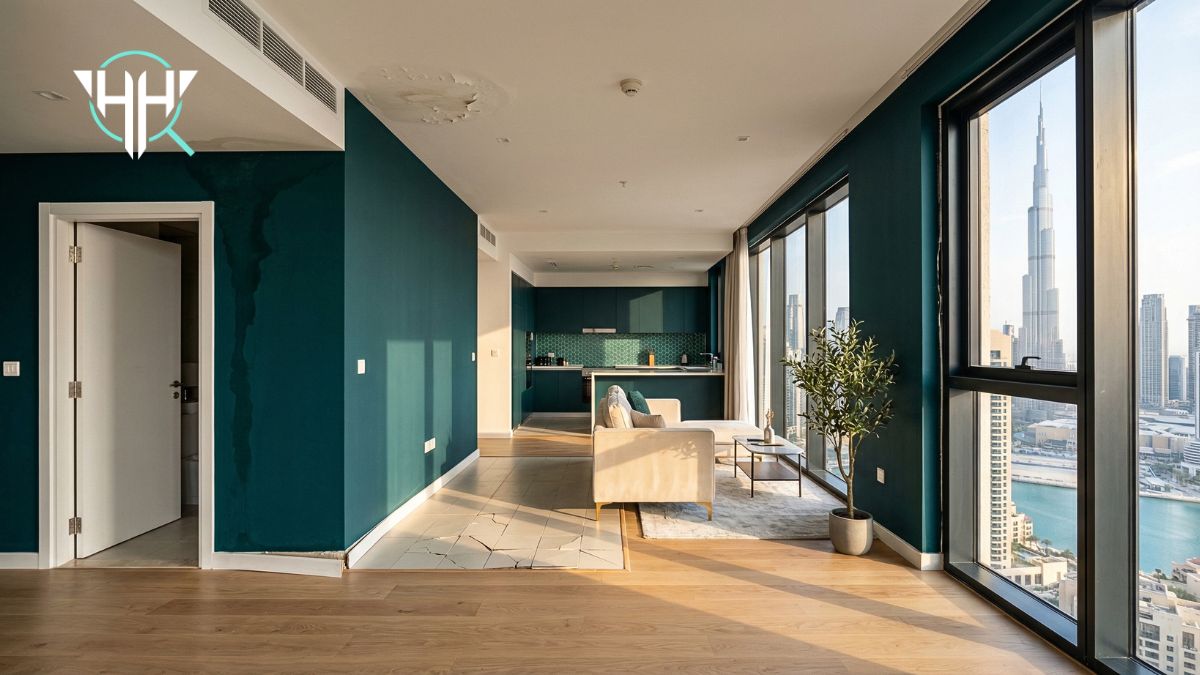
What it looks like: Dripping connections under sinks. Low water pressure at taps or showers. Slow drains that take minutes to clear. Water stains on ceilings (indicating a leak from the floor above or from a pipe run within the slab). In more serious cases, thermal imaging reveals moisture trapped behind bathroom or kitchen walls that is completely invisible to the eye.
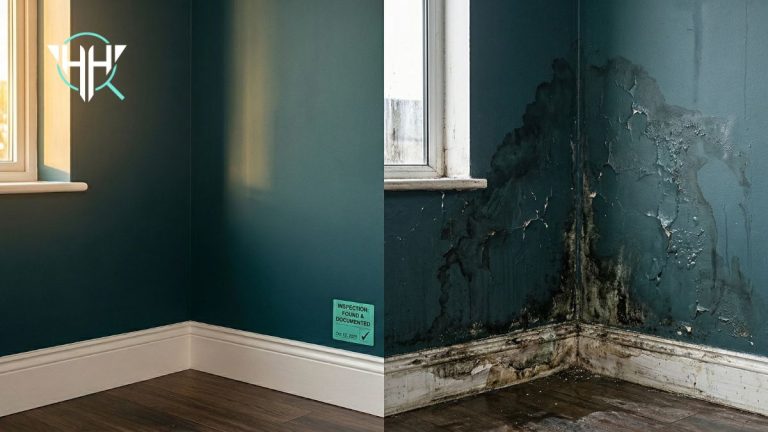
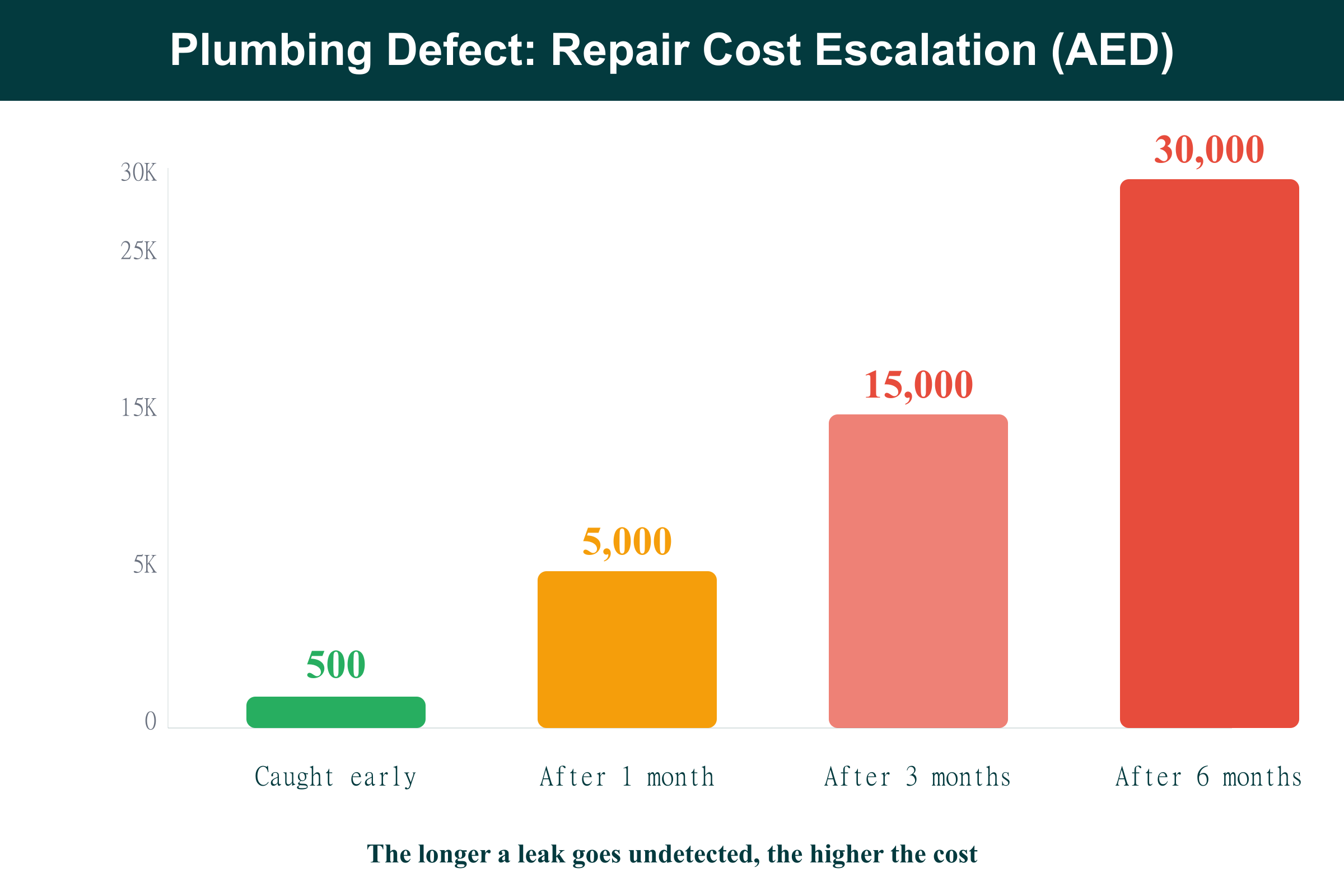
What it costs if missed: A minor leak under a kitchen sink might cost AED 500 to repair if caught early. A hidden pipe leak inside a wall that goes undetected for 6 months can result in AED 10,000 to AED 30,000 in water damage, mould remediation, wall demolition, and restoration. We have seen cases where a single undetected plumbing defect cost the homeowner more than 10 times the price of the inspection that would have caught it.
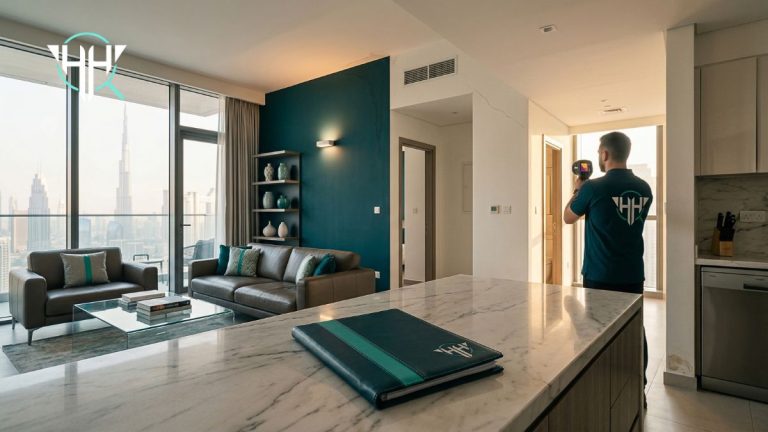
How inspectors detect it: Professional inspectors run every tap, flush every toilet, and test every drain under full pressure. Thermal imaging cameras scan walls and ceilings for temperature anomalies that indicate moisture behind surfaces. This is why thermal imaging is not a luxury add-on. It is essential.
Developer obligation: Plumbing defects are fully covered under the Defect Liability Period. Document them, submit the report, and the developer must fix them at zero cost.
2. HVAC and Air Conditioning Failures
In a city where air conditioning runs for 8 or more months of the year, AC defects are not just uncomfortable. They are a daily financial drain in wasted energy and a health concern if air quality is compromised.
Why it happens: AC systems in new Dubai properties are often installed correctly in terms of hardware but fail during commissioning. Thermostats are not calibrated. Ductwork has gaps or disconnections. Refrigerant levels are incorrect. Condensate drains are improperly routed. These are not manufacturing defects. They are installation and commissioning failures that happen when the final stages of construction are rushed.
What it looks like: Rooms that never reach the set temperature. Uneven cooling where one bedroom is freezing and another is warm. Excessive noise from indoor or outdoor units (vibrations, rattling, humming). Water dripping from indoor AC units onto walls or floors. High DEWA bills relative to similar units in the same building.
What it costs if missed: A thermostat recalibration is a minor fix. A failed compressor is AED 10,000 to AED 20,000 to replace. Ductwork repairs require ceiling access and can cost AED 5,000 to AED 15,000 depending on the extent. And every month your AC runs inefficiently, you are overpaying on electricity. Over a year, that inefficiency can add up to thousands of dirhams in excess DEWA charges.
How inspectors detect it: Inspectors measure the temperature differential between supply and return air in every room. Airflow from each vent is tested. Thermal imaging scans duct runs for leaks and disconnections that are invisible from below the ceiling. Condensate drains are checked for proper flow. Thermostat response is tested against actual room temperature.
Developer obligation: AC and HVAC defects are covered under the 1-year MEP warranty within the Defect Liability Period.
3. Tiling Defects: Hollow Tiles, Lippage, and Poor Grouting
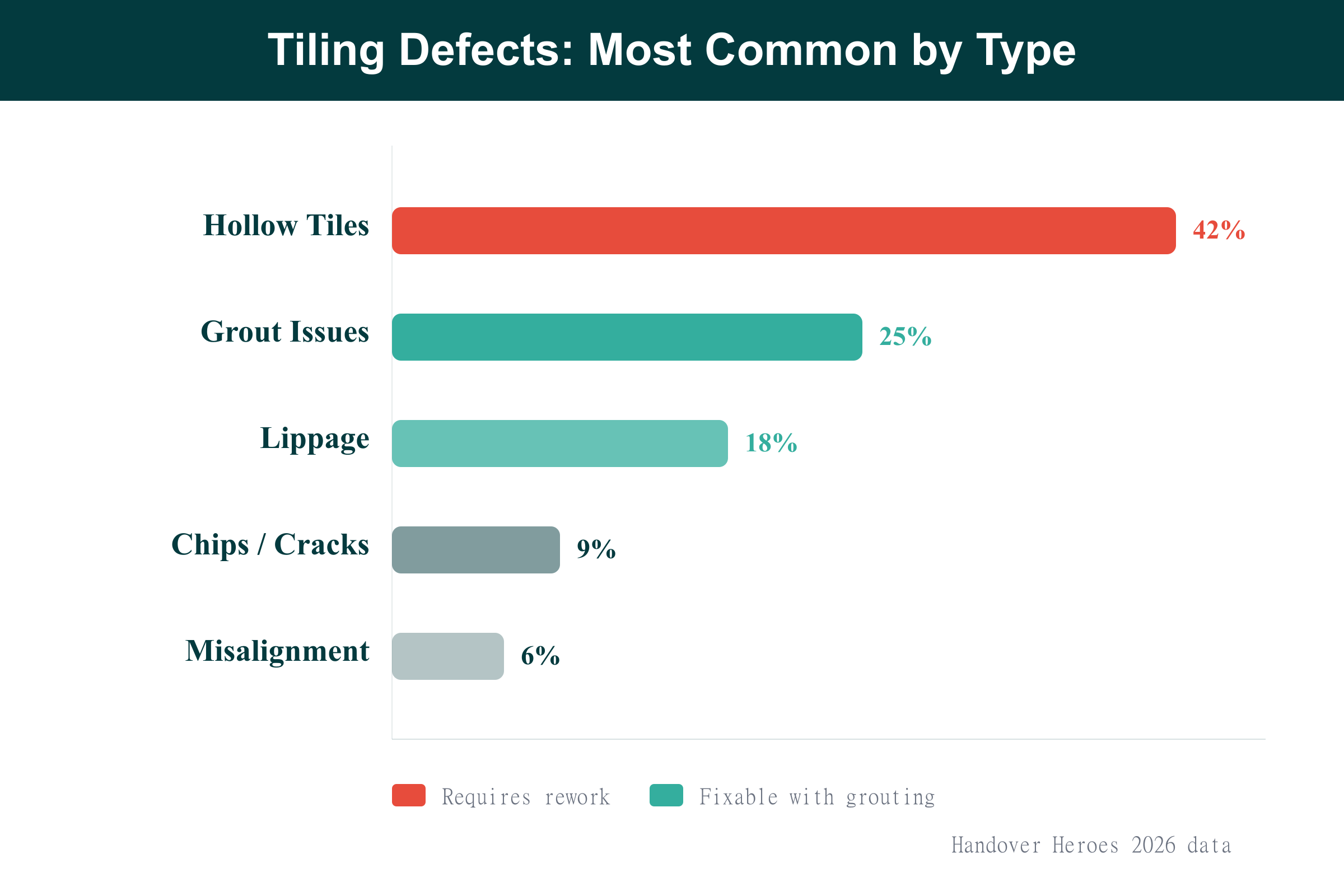
Tiling defects are the single most common category of defect found during snagging inspections in Dubai. Almost every property we inspect has at least a few tiling issues, and many have dozens.
Why it happens: Tiling is labour-intensive and time-sensitive. When construction schedules compress, tilers work faster. Insufficient adhesive is applied (the adhesive does not cover the full back of the tile). Substrate surfaces are not properly leveled before tiling begins. Grout is applied unevenly or before the adhesive has fully cured. The result is tiles that are technically in place but are not properly bonded to the surface beneath them.
What it looks like: Hollow tiles produce a distinct hollow sound when tapped compared to the solid thud of a properly bonded tile. Lippage is where adjacent tiles sit at slightly different heights, creating an uneven surface you can feel underfoot or see at an angle. Grout defects include gaps, inconsistent colour, cracking, and missing sections. Misaligned patterns are visible where tile layouts do not follow a consistent line or where cuts around edges are uneven.
What it costs if missed: A single tile replacement after move-in costs AED 200 to AED 500 including materials, labour, and matching grout. If you have 20 hollow tiles across your kitchen and bathrooms, that is AED 4,000 to AED 10,000. More importantly, hollow tiles crack under weight. A heavy piece of furniture or repeated foot traffic on a hollow tile will eventually cause it to fracture, and by then you are past the DLP window and paying for everything yourself.
How inspectors detect it: Professional inspectors tap-test every single tiled surface in the property. This is not a random spot check. It is a systematic, tile-by-tile assessment across floors, walls, and wet areas. Visual checks are also conducted for lippage, grout quality, pattern alignment, and edge finishing. For a detailed breakdown of the full tiling inspection, see our snagging checklist guide.
4. Electrical Faults and Wiring Issues
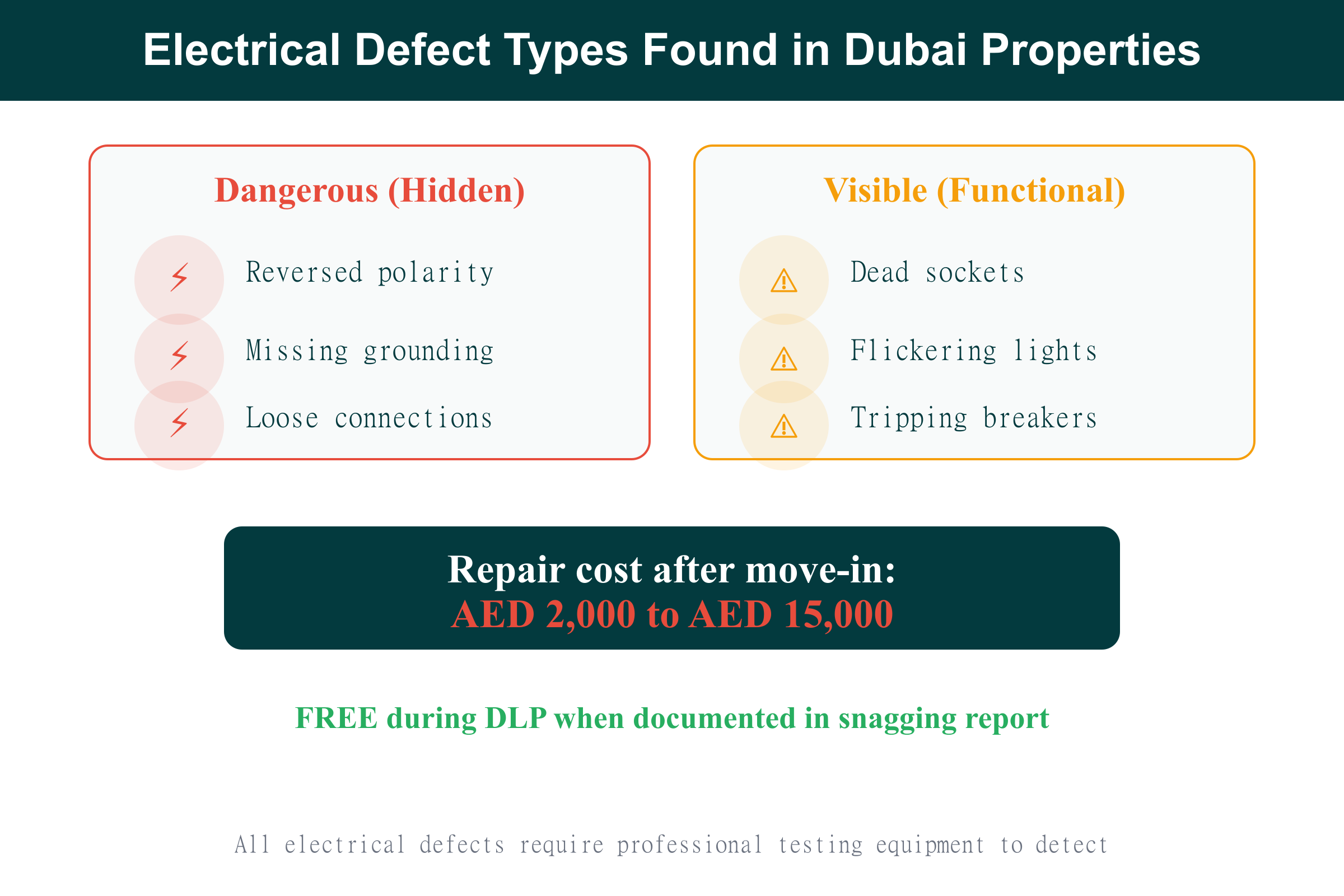
Electrical defects are less common than plumbing or tiling issues, but they are potentially the most dangerous. A reversed polarity socket or a missing ground connection is not something you can see. It requires testing equipment to detect.
Why it happens: Electrical installation in large developments involves hundreds of connection points per unit. Incorrect polarity (where live and neutral wires are swapped), missing grounding, loose connections at junction boxes, and unlabeled circuit breaker panels are all installation errors that pass visual inspection but fail under testing.
What it looks like: Sockets that do not work. Appliances that behave erratically (due to reversed polarity). Lights that flicker. Circuit breakers that trip frequently without apparent cause. In the worst cases, these faults create fire risk or electrocution hazard that is entirely invisible until something goes wrong.
What it costs if missed: Fixing a single reversed polarity socket is straightforward if caught during snagging. Rewiring a section of the property after move-in, when walls are painted and furniture is in place, costs AED 2,000 to AED 15,000 depending on the extent. A full breaker panel correction can cost AED 3,000 to AED 5,000. And the cost of an electrical fire or appliance damage from faulty wiring is incalculable.
How inspectors detect it: Every socket is tested with a professional socket tester that checks polarity, grounding, and fault conditions. Light switches are tested in all positions. The circuit breaker panel is audited for correct labeling and proper sizing. In properties with smart home systems, automation controls and their electrical integration are also verified.
Developer obligation: Electrical defects are covered under the 1-year MEP warranty within the DLP. Report them immediately through your inspection report.
5. Paint, Finishing, and Cosmetic Defects
Cosmetic defects are the most visible and the most numerous. They are rarely dangerous, but they are the defects that affect your daily experience of living in the property and its resale value.
Why it happens: Painting and finishing are the last trades to complete before handover, and they are almost always rushed. Workers paint over dust, debris, and incomplete plaster. Coats are applied too thinly or unevenly. Skirting boards are installed quickly without checking alignment. Joinery receives a quick wipe-down rather than a proper quality check. The result is a property that looks clean from a distance but reveals significant imperfections up close.
What it looks like: Paint runs, drips, and roller marks on walls. Uneven colour consistency between walls in the same room. Missed spots where the base coat shows through. Scuff marks and scratches from other trades working after the painters finished. Skirting board gaps where the board does not sit flush to the wall or floor. Ceiling coving that does not meet at clean angles. Rough plaster patches visible under angled light.
What it costs if missed: Repainting a single room after move-in costs AED 500 to AED 1,500 depending on size and finish. Fixing skirting, coving, and joinery issues costs AED 1,000 to AED 3,000. The disruption of having painters and tradespeople in your furnished, occupied home is an additional cost that does not show up on any invoice.
How inspectors detect it: Systematic visual inspection under both natural and artificial light is the primary method. Professional inspectors use raking light (an angled torch beam across the wall surface) to reveal imperfections that are invisible under normal overhead lighting. Every wall, ceiling, skirting line, and piece of joinery is assessed at close range.
Why it matters beyond aesthetics: Cosmetic defects directly affect your property’s resale value. A buyer viewing a property with visible paint defects, misaligned skirting, and poor joinery quality will either negotiate the price down or walk away entirely. Fixing these issues under the DLP costs nothing. Fixing them after the DLP costs money and time.
Why Common Defects in Dubai Properties Go Unnoticed
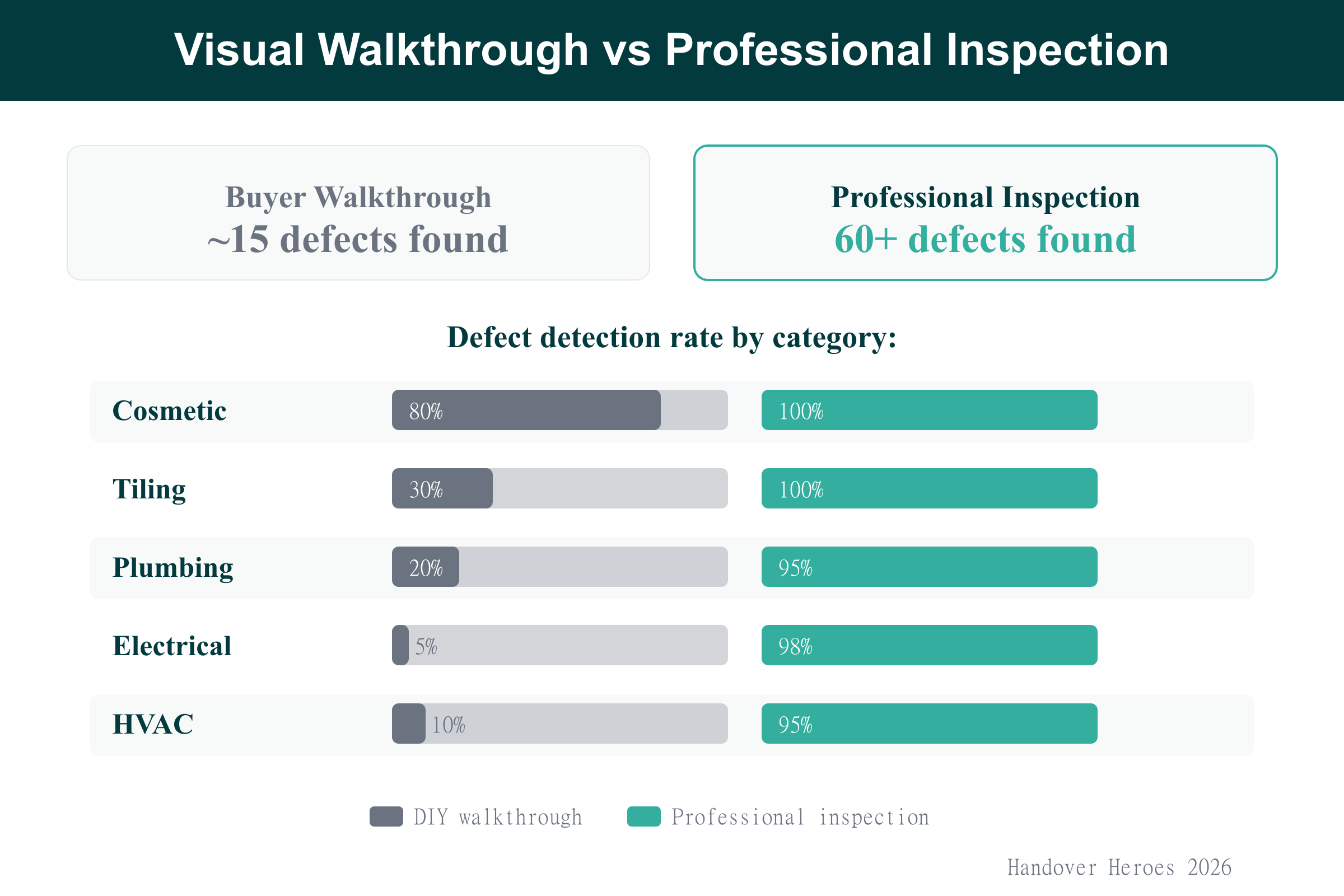
Most buyers walk into their new property for the first time feeling excited. They are looking at the view, imagining their furniture layout, and picturing their life in the new space. They are not thinking about reversed polarity sockets or hollow tiles in the guest bathroom.
Developer walkthroughs are designed to be brief and positive. The representative walks you through the property, points out the features, and hands you a form to sign. The lighting is controlled. The walkthrough is fast. And many defects are simply not detectable without specialist equipment, systematic testing, and a trained eye.
Some defects only appear under specific conditions. A plumbing leak may only manifest when multiple taps are running simultaneously. An AC issue may only become apparent when the system is running under full load on a hot day. Hollow tiles do not look any different from properly bonded tiles. They only reveal themselves when tapped.
This is exactly why professional snagging exists. For a complete overview of what a professional inspection checks, see our full snagging checklist for Dubai properties. To understand the costs, see our guide to property snagging cost in Dubai.
How to Protect Yourself Before Signing Your Handover
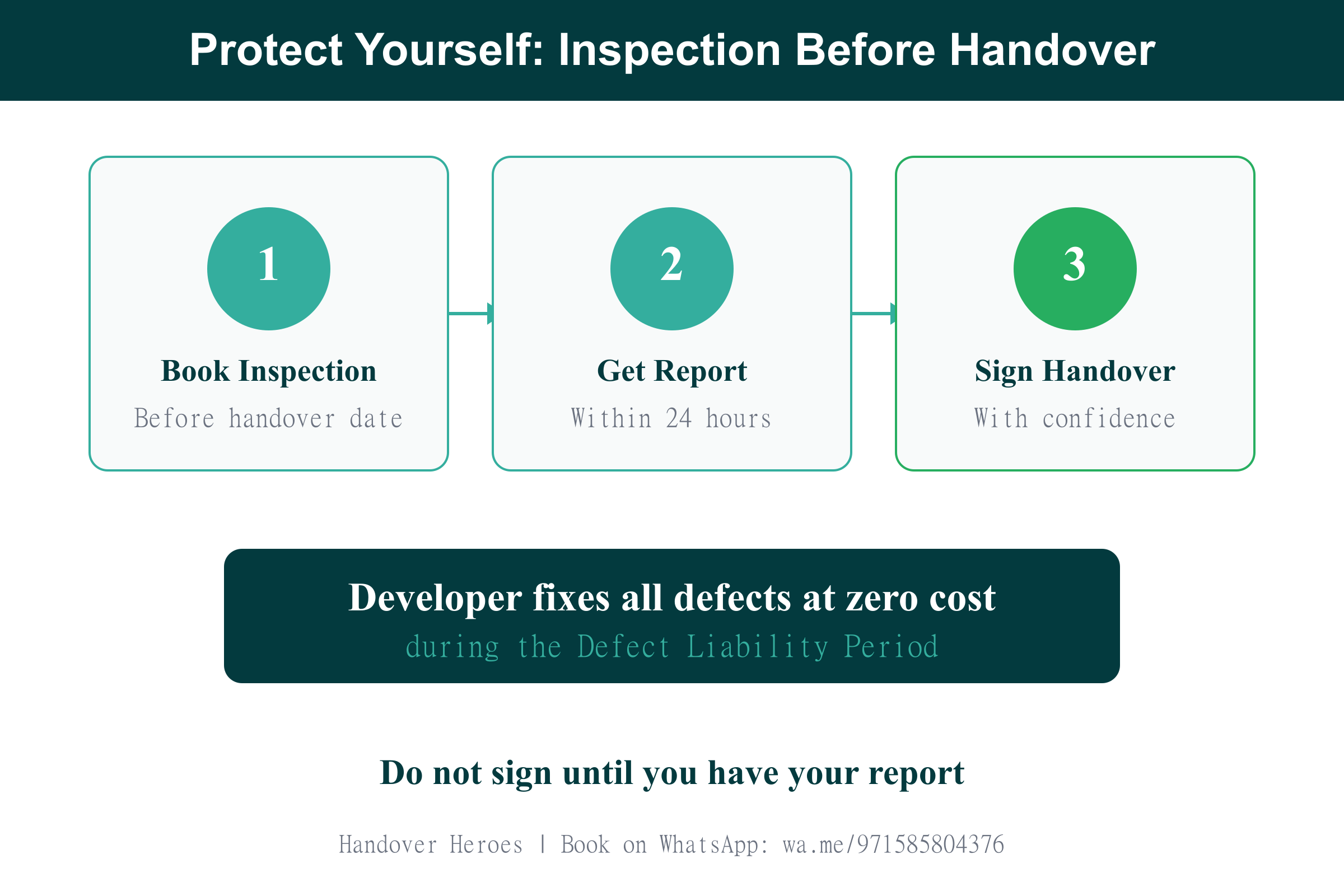
The most effective protection is simple: book a professional pre-handover inspection before you sign the handover documents.
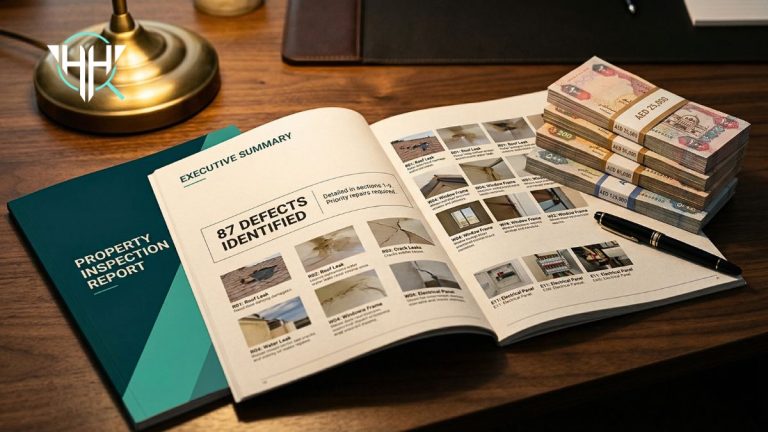
A certified inspection team will systematically assess every system and surface in your property using the full 200+ point snagging checklist. Every defect is photographed, annotated, and compiled into a detailed report that you submit to the developer. The developer is then legally required to fix every qualifying defect at their cost during the Defect Liability Period.
Do not sign the handover form until you have your inspection report in hand. Once you sign, your leverage drops significantly.
Book your pre-handover inspection on WhatsApp or visit our pre-handover inspection page for full details.
Frequently Asked Questions About Common Defects in Dubai Properties
How many defects does a typical Dubai property have?
Based on our inspection data, a typical apartment in Dubai has between 30 and 80 defects. Townhouses average 50 to 120, and villas can exceed 150. The majority are cosmetic and tiling issues, but every property also has MEP defects that require specialist equipment to detect. The total count depends on property size and developer quality standards.
Can I do my own snagging inspection?
You can conduct a basic visual walkthrough and catch obvious cosmetic issues like paint defects and scratched surfaces. However, the most expensive defects (plumbing leaks, electrical faults, hollow tiles, AC failures) are hidden and require thermal imaging cameras, electrical testers, moisture meters, and systematic testing to detect. A professional inspection typically catches 3 to 5 times more defects than a DIY walkthrough.
Should I snag before or after signing the handover?
Before. Always before. Once you sign the handover documents, your negotiating leverage with the developer decreases significantly. Book your inspection before the handover appointment, attend with your report in hand, and negotiate any outstanding items before you sign. Your rights under Dubai property law are strongest before the handover signature.
What happens if the developer refuses to fix defects?
If a developer refuses to address legitimate construction defects during the Defect Liability Period, you can file a formal complaint with RERA through the Dubai REST app, escalate to the Dubai Land Department dispute resolution centre, or pursue the matter through the Dubai courts. A professional inspection report with photographs and annotations is your primary evidence at every escalation stage.