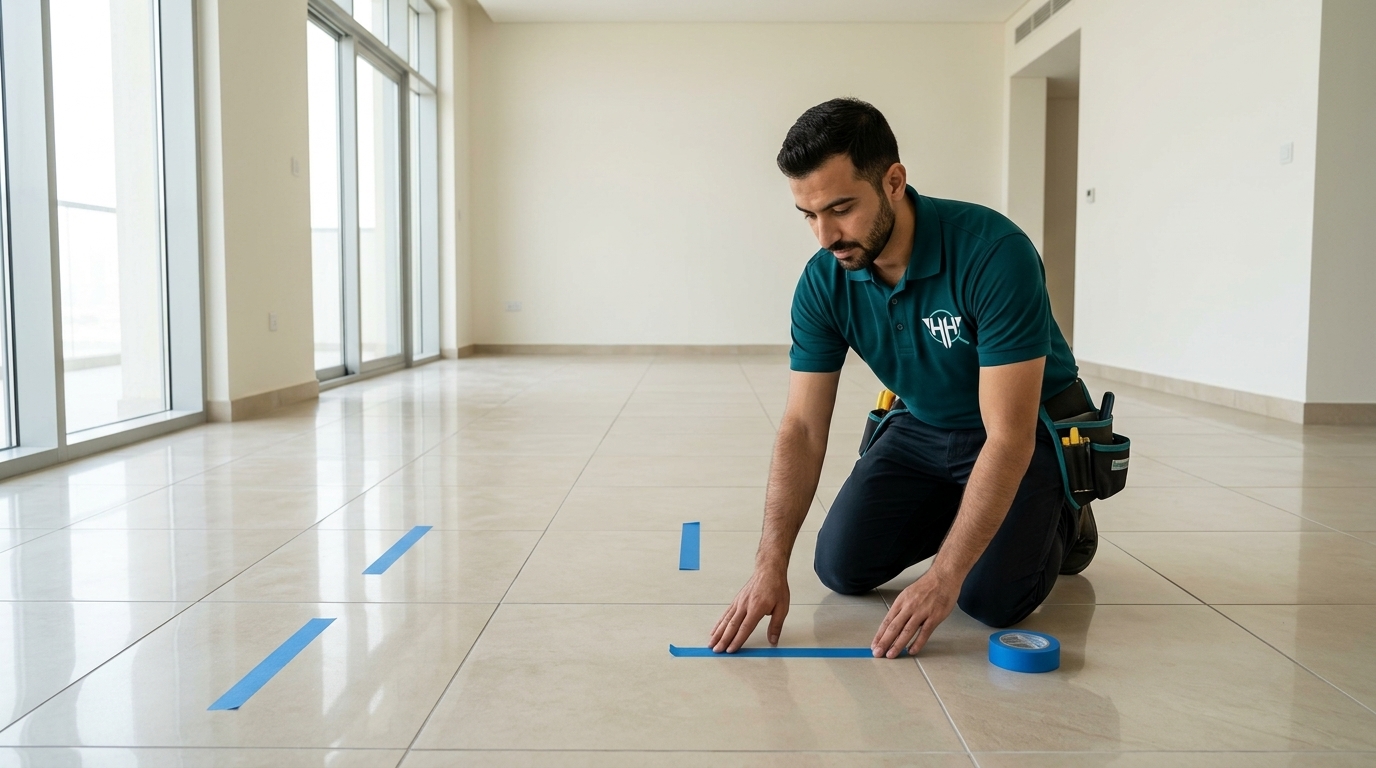
Hollow Tiles: A Snagging Inspector’s Guide to Finding Them Before They Crack
Of every defect we document in a UAE handover, hollow tiles are the one owners are most surprised by. Not because they are rare, but because there is nothing to see. A tile that has not bonded to the screed beneath it looks identical to one that has. Same finish, same grout line, same reflection. The difference is entirely underneath, and it stays invisible until the day it cracks.
This guide explains what we look for, how the hollow tile test actually works, and what your options are depending on when you find out. For context on handover rights and developer obligations, the UAE Government housing information portal is a useful reference.
What a Hollow Tile Actually Is
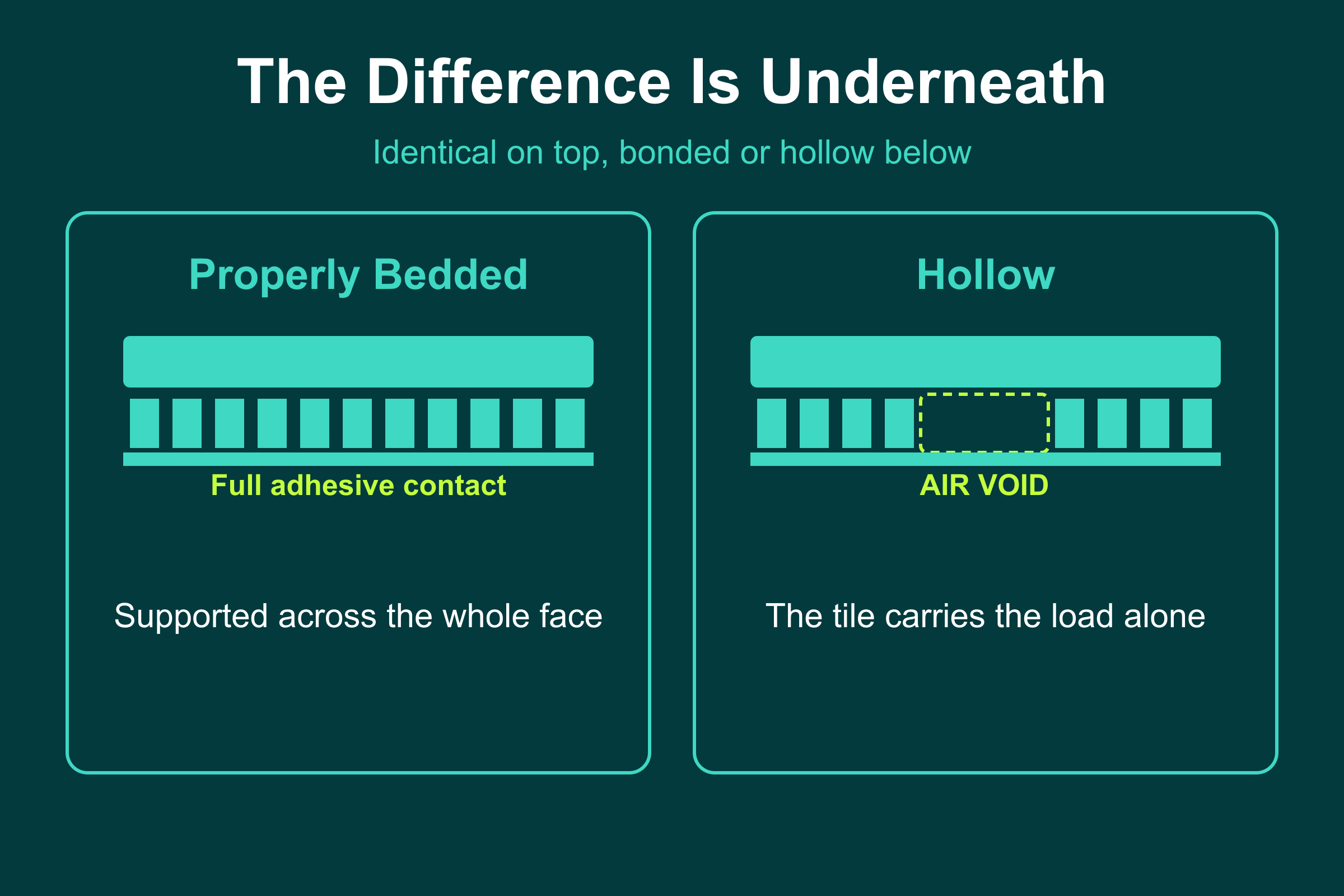
When a tile is laid correctly, adhesive covers the back of it almost completely and bonds it to the substrate. The industry target for full coverage varies by application, but the principle does not: the tile should be supported across its whole face, not just at the edges or in dabs.
A hollow tile is one where that coverage failed. Air sits in the void between the tile and the screed. That void has no structural value, so any load applied over it is carried by the tile alone, unsupported.
Large-format tiles, which are now standard across UAE developments, make this worse in two ways. A larger tile spans a larger void, and it has more unsupported area to flex across. It is also heavier, which makes correct bedding harder to achieve on site at pace.
Why It Happens So Often Here
There is nothing unusual about UAE construction that causes hollow tiles. What there is, is volume and speed.
A single villa community may involve tens of thousands of square metres of tiling completed to a programme. Tiling crews work quickly, adhesive is mixed and applied at pace, and some proportion of that work will fall short of full bedding. That is true of high-volume construction anywhere in the world, and it is why independent inspection exists as a discipline rather than as an accusation.
We find hollow tiles in properties from developers with excellent reputations. It is not a signal that the builder is careless. It is a signal that construction at scale produces variance, and that variance needs catching.
The Hollow Tile Test
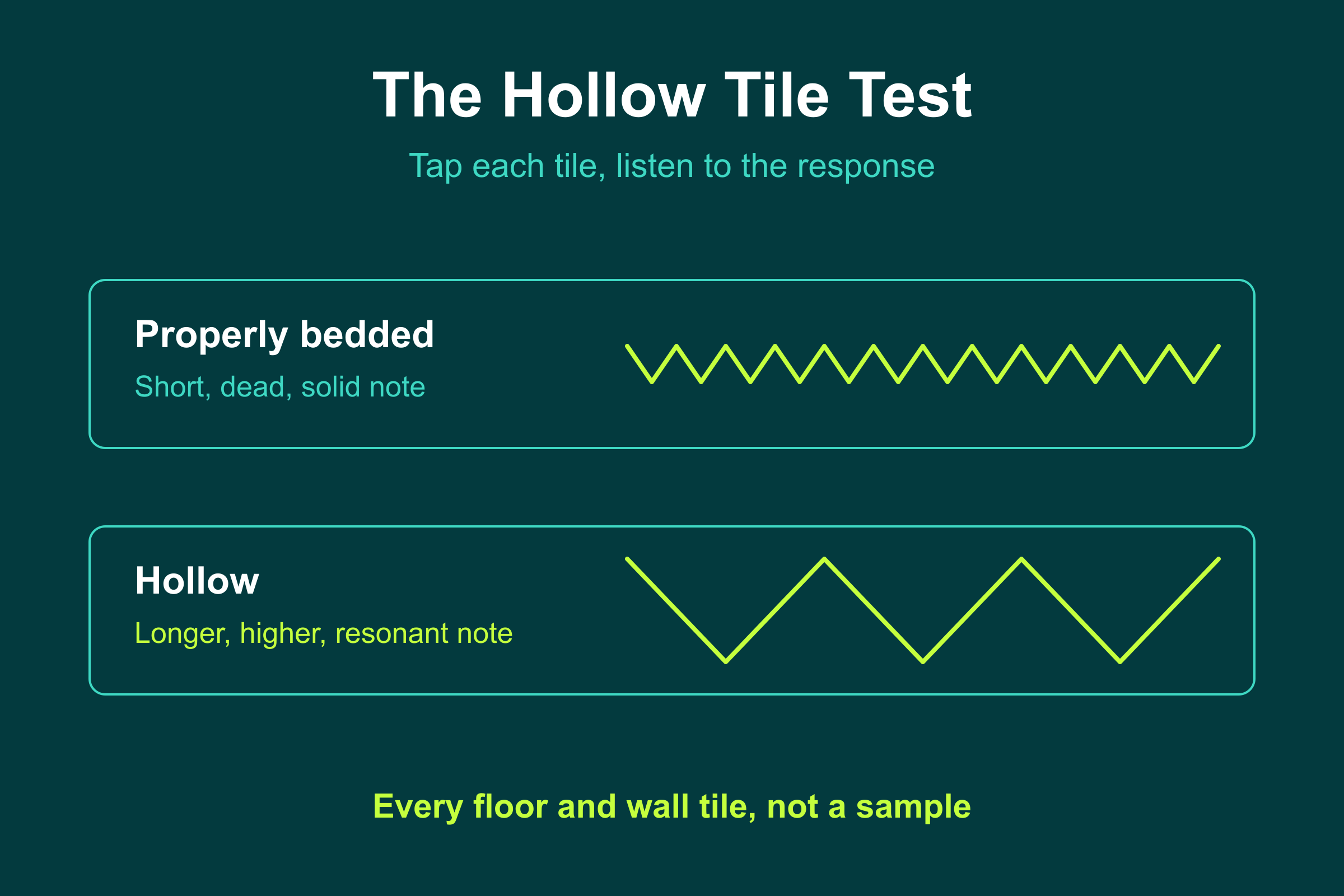
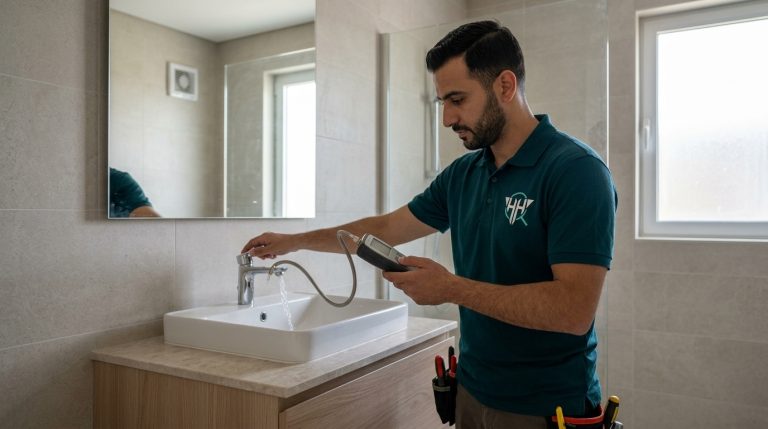
The hollow tile test is sounding, and it is genuinely simple. We tap each tile with a drum hammer, a light tool with a rounded head, and listen to the response.
A properly bedded tile returns a short, dead, solid note. The sound stops almost immediately because the adhesive and screed absorb the energy.
A hollow tile returns a longer, higher, resonant note. The void acts as a small drum, which is where the tool gets its name. Once you have heard the difference a few times the hollow tile test is unmistakable, and it does not require interpretation or judgement.
What matters is coverage. In the hollow tile test we tap every floor and wall tile in the property, not a sample. The same discipline applies in the bathrooms, where our wet area inspection checks tiling and waterproofing together. A sample tells you a property has hollow tiles somewhere, which is not actionable. A complete map tells the developer exactly which tiles to lift, and gives you a defect list that is specific enough to be acted on rather than argued about.
On a villa this is a meaningful portion of the three to five hours we spend on site, and it is time we do not compress.
The Cost Curve, and Why Timing Decides It
Here is the part that matters commercially.
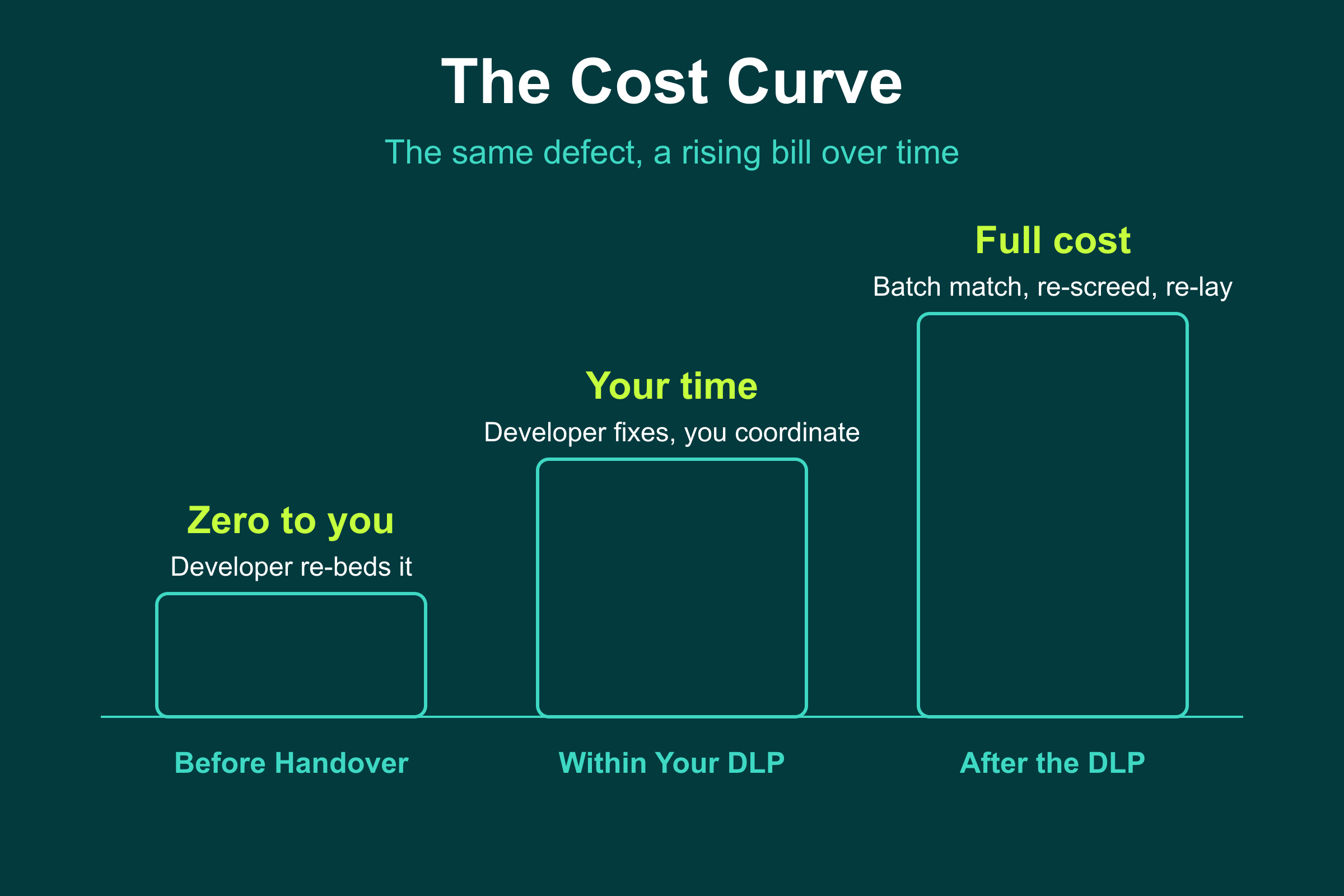
Found before handover, a hollow tile is a line on a defect schedule. The developer lifts it, re-beds it, and replaces it from the same batch that is still on site. Your cost is zero.
Found after you have signed but within your defect liability period, it is still the developer’s responsibility, an accountability overseen by the Real Estate Regulatory Agency (RERA), but you are now coordinating access, scheduling contractors around your occupancy, and living with disruption in a home you have moved into.
Found after your defect liability period closes, it is yours. And the cost is not the tile. It is matching a tile batch that may no longer be manufactured, lifting adjacent tiles to get a clean removal, re-screeding, re-laying, re-grouting, and accepting that a patch repair in a large-format floor is often visible under raking light.
This is why the defect that looks smallest on the schedule frequently produces the largest regret, and why the hollow tile test earns its place in the inspection.
What To Do If You Are Already Past Handover
If you have moved in and a tile has cracked, check your defect liability period before anything else. If you are still inside it, document the crack with photographs and a dated note, and report it in writing immediately to the developer and, where relevant, through the Dubai Land Department channels. Do not have it repaired privately first, because that can compromise your claim.
If you are inside your period but nothing has cracked yet, an inspection is still worth doing. Documenting hollow tiles while they are intact is a far stronger position than reporting a crack later and arguing about whether it was a construction defect or accidental damage.
If your period has closed, the decision becomes economic. Tiles in low-traffic areas without furniture over them may never crack. Tiles under a dining table, a sofa or a kitchen island will.
Our Honest Advice
Have the hollow tile test done before you sign. It is the single most common defect we document, it is entirely invisible to a visual inspection, and its cost profile gets dramatically worse with time.
If you take nothing else from this guide, take this: a tile that sounds different today will look different in a year.
Handover Heroes carries out full property snagging across the UAE. Every floor and wall tile sounded, alongside all 13 systems and 500+ checkpoints, with a documented report and video proof within 24 hours. You can estimate the scope and cost with our snagging cost calculator.
WhatsApp +971 58 580 4376 or visit handoverheroes.ae.