Electrical Testing at Handover: The Defects With No Visual Signal
Most defects give you something to look at. A crack, a stain, a gap, a poor finish. Electrical defects give you nothing at all. A socket that is wired incorrectly is visually identical to one that is wired correctly, and it will power your appliance without complaint.
That combination, invisible and functional, is why electrical testing is the part of a snagging we are least willing to compress. For the handover rights that sit behind it, the UAE Government housing information portal is a useful reference.
Reverse Polarity, Explained Plainly
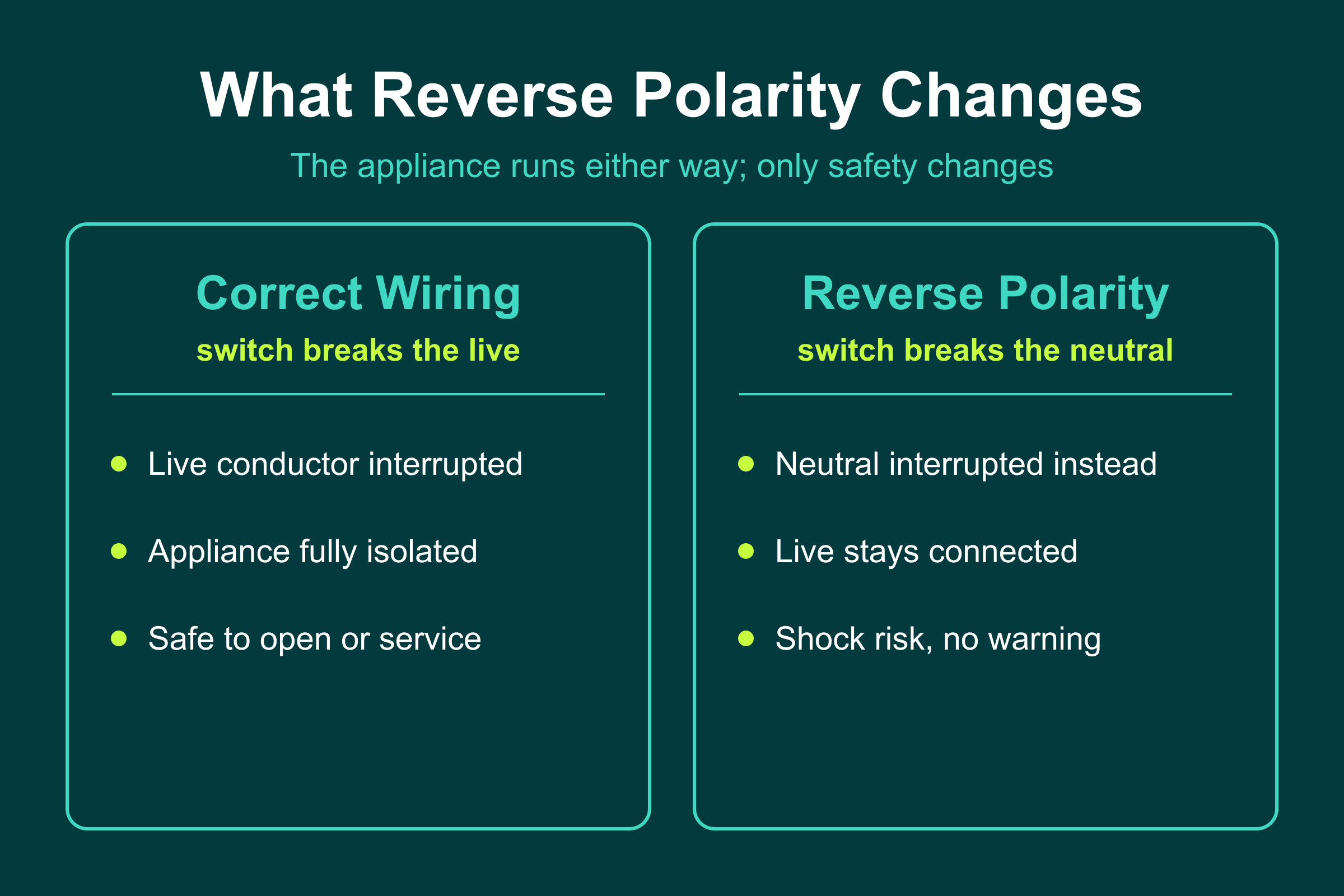
In a correctly wired socket, live and neutral each go to a defined terminal. Reverse polarity means those two have been swapped behind the faceplate.
The appliance still works, because most appliances will run either way. The problem is what happens when you switch it off. In a correctly wired circuit, the switch interrupts the live conductor and the appliance is isolated. With polarity reversed, the switch interrupts neutral instead, and parts of the appliance remain connected to live potential even when it appears to be off.
For a lamp, that means a bulb holder that is live while the lamp is switched off. For anything you open, service or unplug carelessly, it is a shock risk that gives no warning.
It is also completely undetectable without a tester. There is no visual indication, no smell, no sound, no flicker.
Grounding, and Why It Only Matters Once
The earth conductor does nothing during normal operation. It exists for a single scenario: when a fault puts live potential onto something metallic that you might touch, the earth path carries that current away and triggers the protective device.
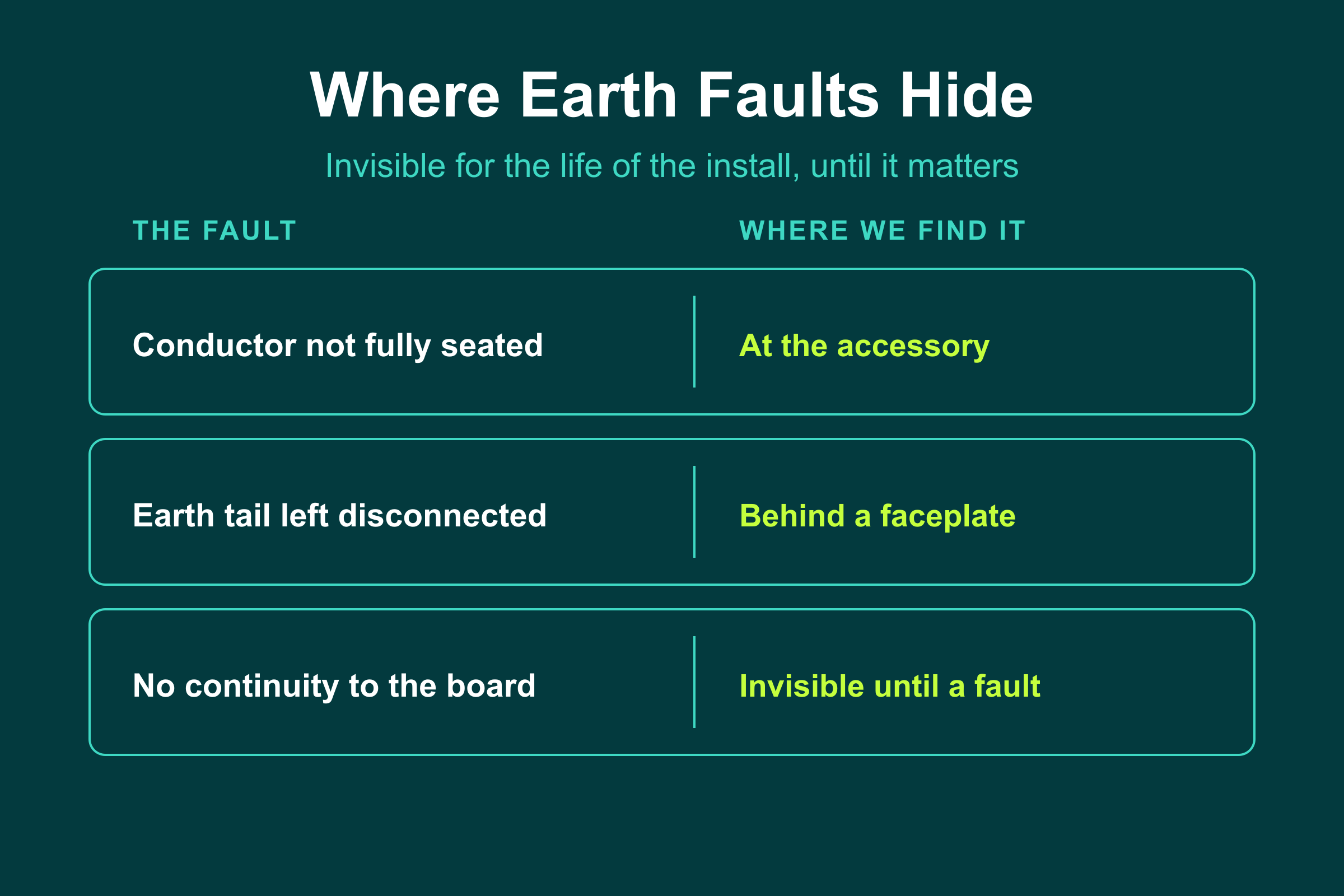
A missing or poorly terminated earth is therefore invisible for the entire life of the installation, right up until the moment it is the only thing standing between a fault and a person. At that point it either works or it does not.
We find earth faults in new properties more often than most owners would expect, usually at the accessory rather than in the distribution board: a conductor not fully seated in a terminal, or an earth tail left disconnected behind a faceplate during second fix.
What Electrical Testing Actually Checks
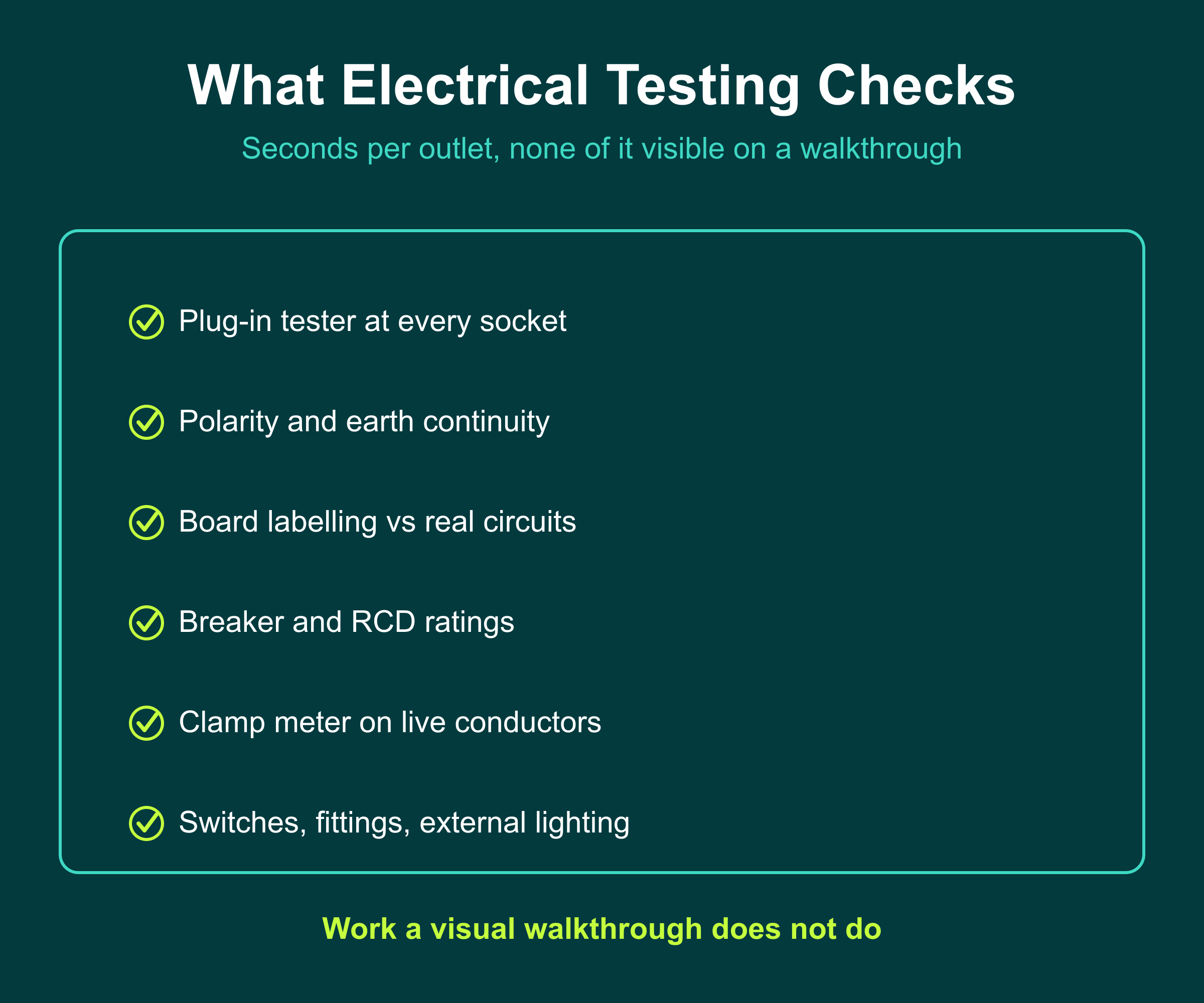
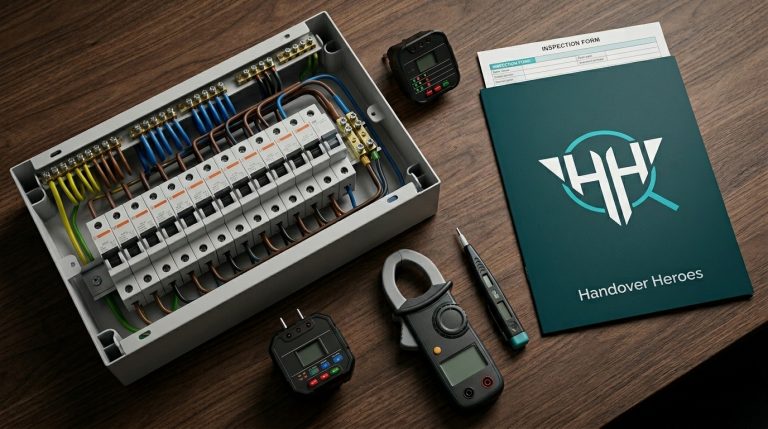
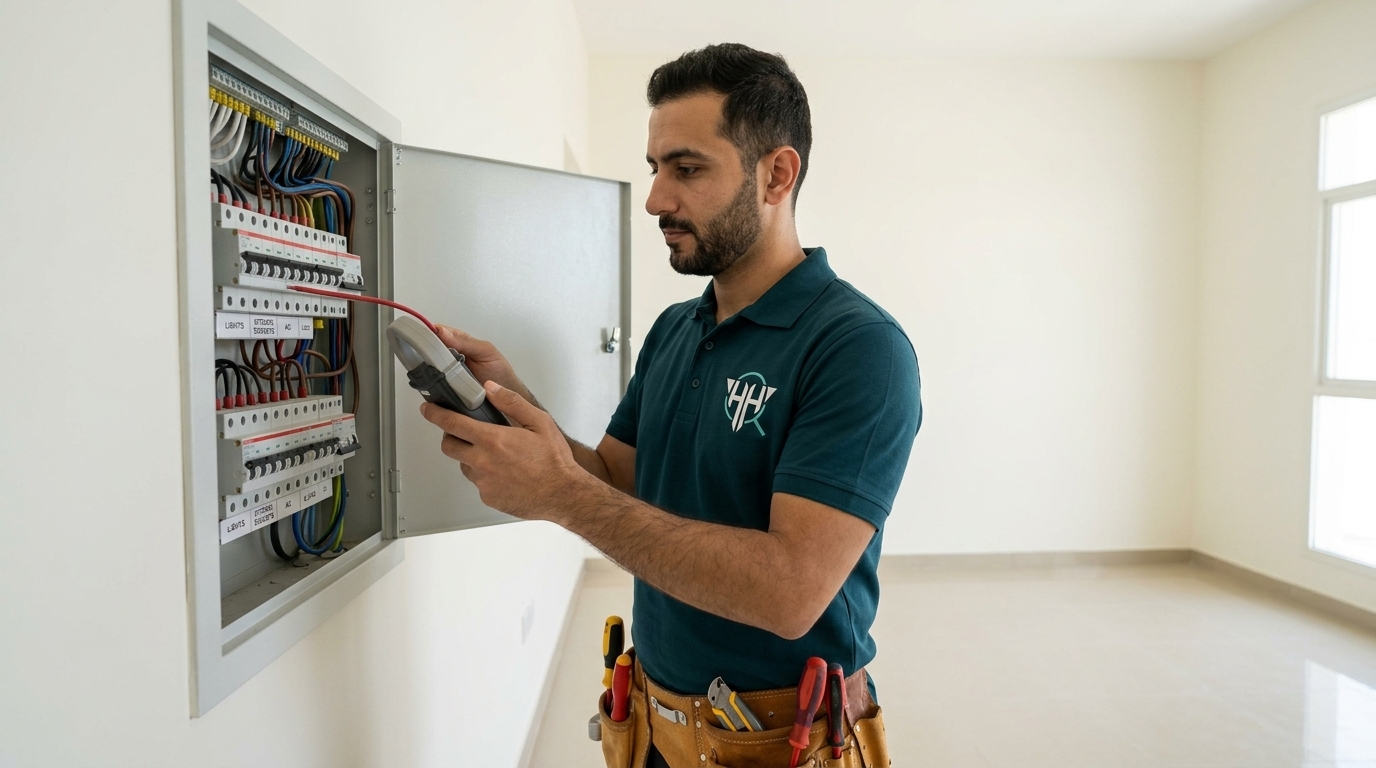
Every socket in the property gets a plug-in tester. It takes seconds per outlet and reports polarity and earth continuity immediately.
At the distribution board we check labelling against the actual circuits, confirm breaker and RCD ratings are appropriate for what they serve, and use a clamp meter to read current in live conductors, which identifies loading problems and circuits behaving unexpectedly.
We check every light switch and fitting for correct operation and secure fixing, external and landscape lighting for weatherproofing, and cable containment for complete cover.
None of this is exotic. Electrical testing is simply work that a visual handover walkthrough does not do, and that the majority of buyers have no way of doing themselves.
Why Labelling Is Not a Trivial Point
Owners often treat distribution board labelling as cosmetic. It is not.
An unlabelled or mislabelled board means that in an emergency, or during any future work, nobody can isolate the right circuit quickly. Every electrician who attends your property afterwards will either waste time working it out or guess.
It is also one of the easiest items to have corrected before handover and one of the most irritating to get done afterwards, because it requires an electrician to attend and trace circuits that should have been documented at commissioning.
What To Check Yourself
There is genuinely useful work you can do at a viewing.
Operate every switch and confirm it controls what you would expect.
Open the distribution board and look at the labelling. If it is blank, generic, or clearly copied from a template, note it.
Look for accessories that are not sitting flush, are cracked, or have visible gaps around them.
What you cannot do without equipment is verify polarity or earth continuity. A plug-in socket tester is inexpensive and worth owning, but interpreting a distribution board and reading circuit current is not a homeowner exercise.
Our Honest Advice
Treat electrical as the category where the gap between what you can see and what is actually true is widest.
Everything else on a snagging report you could eventually have discovered yourself, given enough time and attention. Electrical defects are the ones you would never have found, and they are the ones with a safety consequence rather than a cost consequence.
Have every socket tested before you sign. Because an electrical defect is a developer responsibility, documenting it through electrical testing keeps it their obligation to fix within the defect liability period, under the Real Estate Regulatory Agency (RERA) framework.
Handover Heroes carries out electrical testing on every socket, switch and circuit as part of a full property snagging, alongside all 13 systems and 500+ checkpoints, with a documented report and video proof within 24 hours. You can estimate the scope and cost with our snagging cost calculator.
WhatsApp +971 58 580 4376 or visit handoverheroes.ae.