Finding Moisture Before It Finds You: An Inspector’s Guide
By the time moisture is visible, it has been present for a long time.
A stain on a ceiling or a dark patch above a skirting is not the beginning of a problem. It is the point at which enough water has moved through enough material for long enough to change the appearance of the surface. The hidden moisture that caused it happened weeks or months earlier, out of sight.
That lag is the reason moisture detection exists as a discipline, and the reason we do not rely on looking. For the handover rights that sit behind it, the UAE Government housing information portal is a useful reference.
Where Hidden Moisture Actually Starts in New Properties
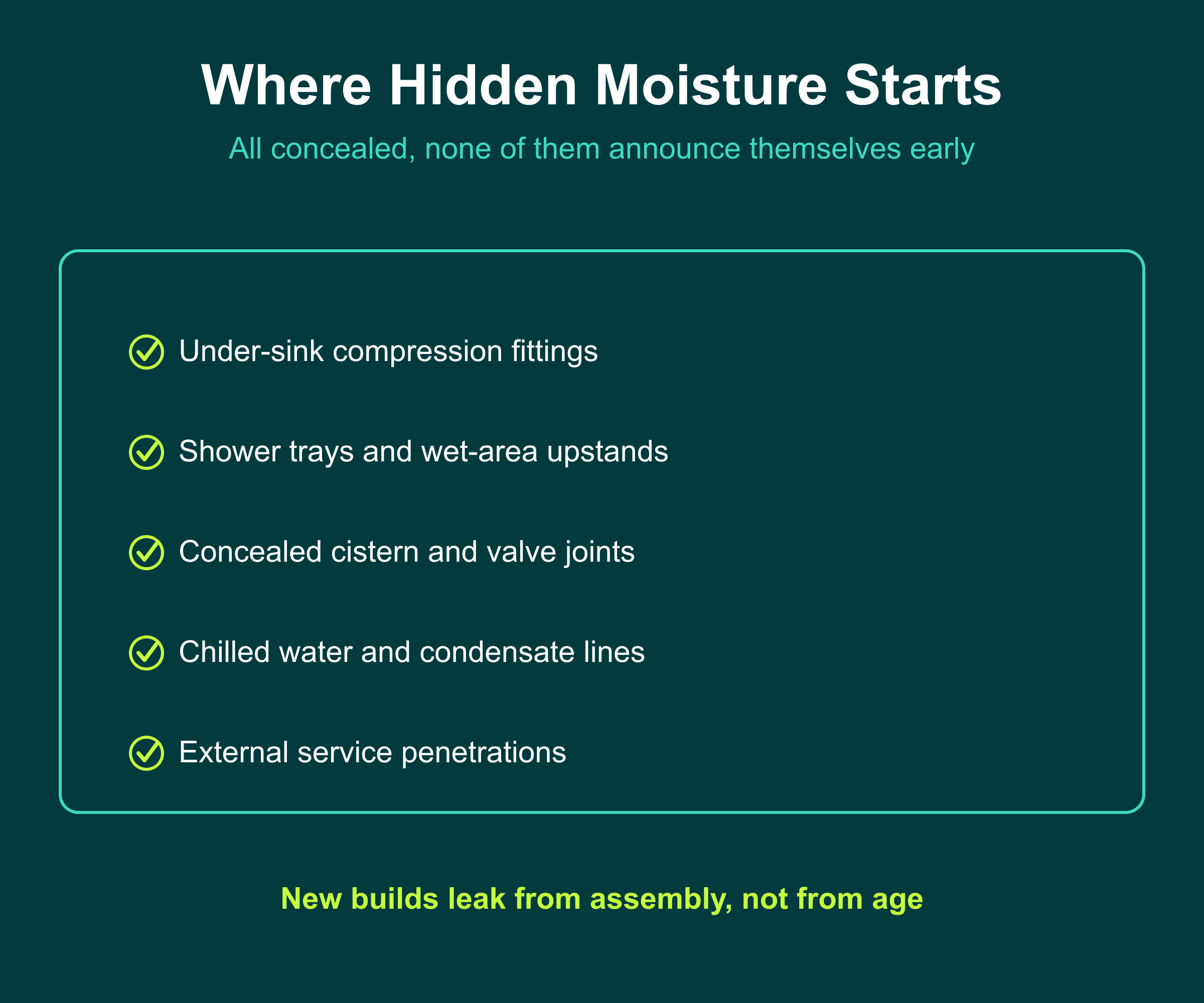
In a brand new property, moisture almost never comes from a failed component. Components fail with age. New properties leak because of how they were assembled.
The recurring sources we document are concentrated in a few places.
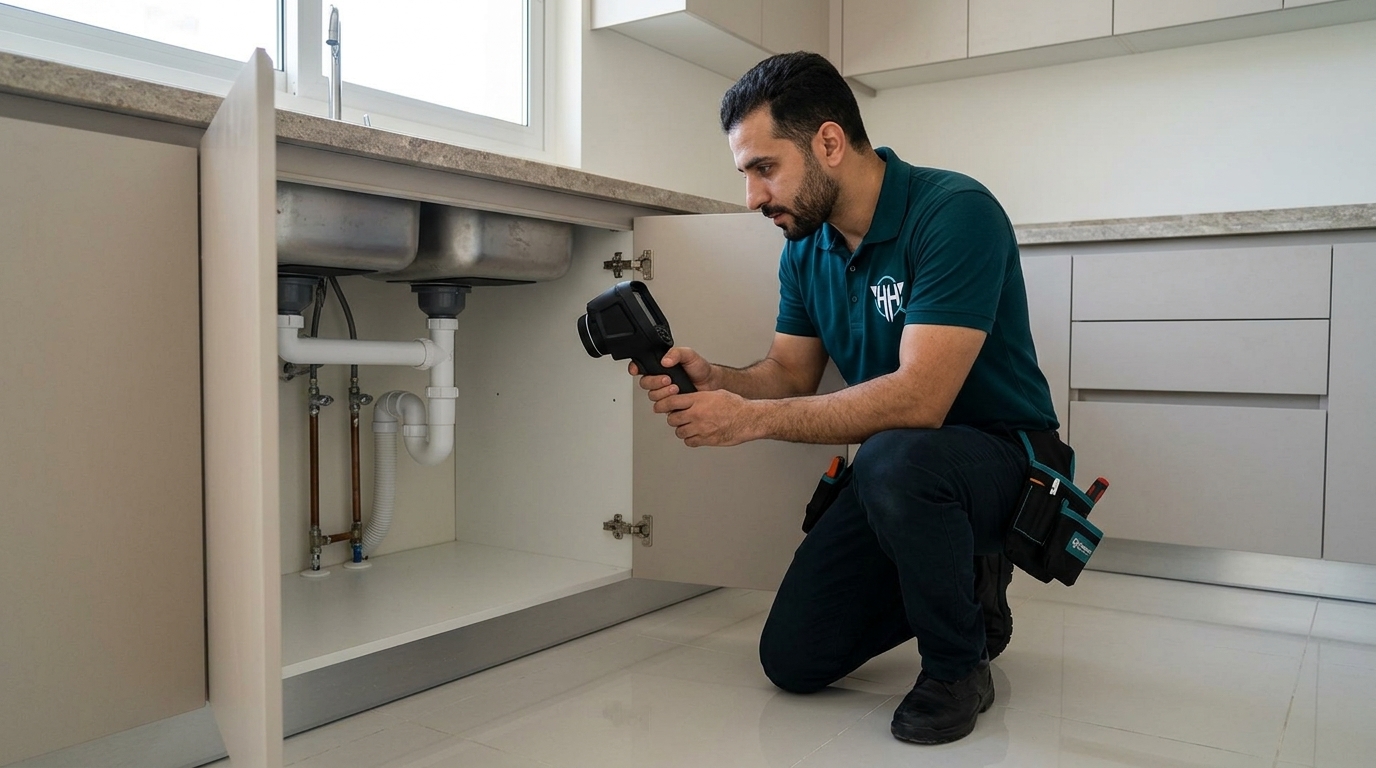
Waste and supply connections under sinks and basins, where a compression fitting was not fully tightened during second fix. These weep rather than leak, which is why nothing dramatic happens for months.
Shower trays and wet area upstands, where waterproofing was completed correctly but a penetration was made afterwards for a fixing.
Cistern and concealed valve connections behind bathroom panels, which are inaccessible after tiling.
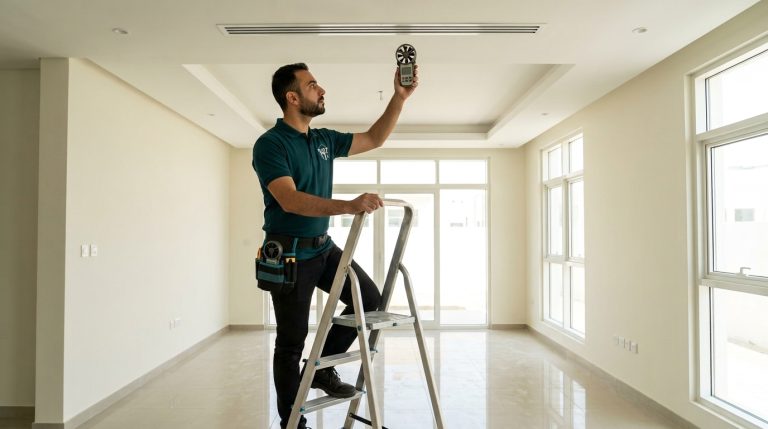
Chilled water pipework and condensate lines in ceiling voids, which produce condensation rather than leakage when insulation is missing or split.
External wall penetrations for services, where the sealant was applied thinly or has already cracked.
What these have in common is that they are all concealed, and none of them announce themselves early.
Thermal Imaging, and What It Genuinely Does
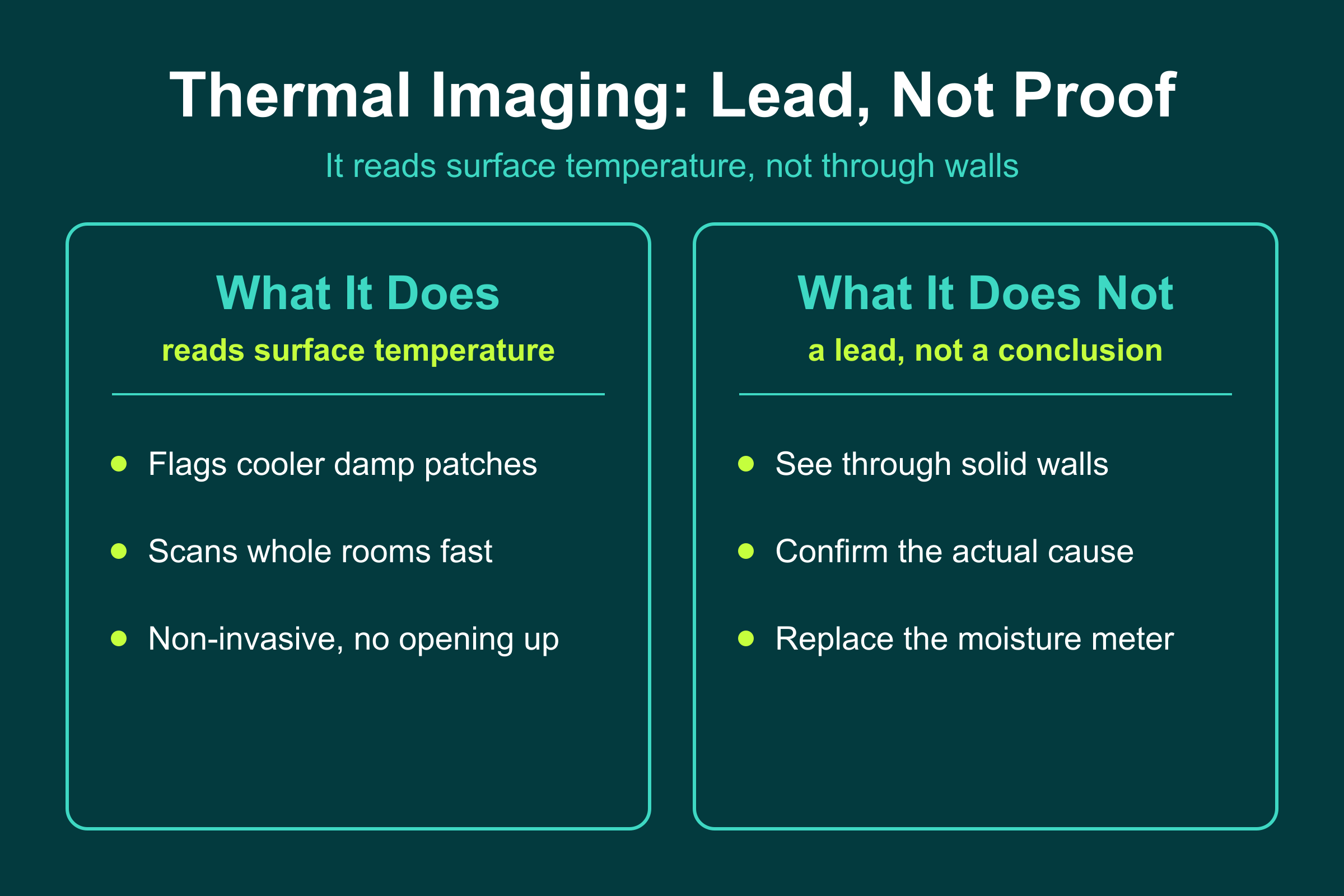
A thermal camera does not see through walls, despite how it is often described. It reads surface temperature.
That is enough, because moisture changes surface temperature. Evaporation cools a damp area relative to the dry material around it, so a wet patch behind plaster appears as a cooler region on the surface long before it discolours. In a ceiling void with an air conditioning leak, the reverse can apply.
This lets us scan large areas quickly and non-invasively, and it is the only practical way to survey an entire property for hidden moisture within a single visit.
What thermal imaging does not do is confirm the cause. A cool area might be moisture, a thermal bridge, a cavity in the plaster, or a chilled pipe running behind the wall. That is why the reading is a lead rather than a conclusion.
Confirming It
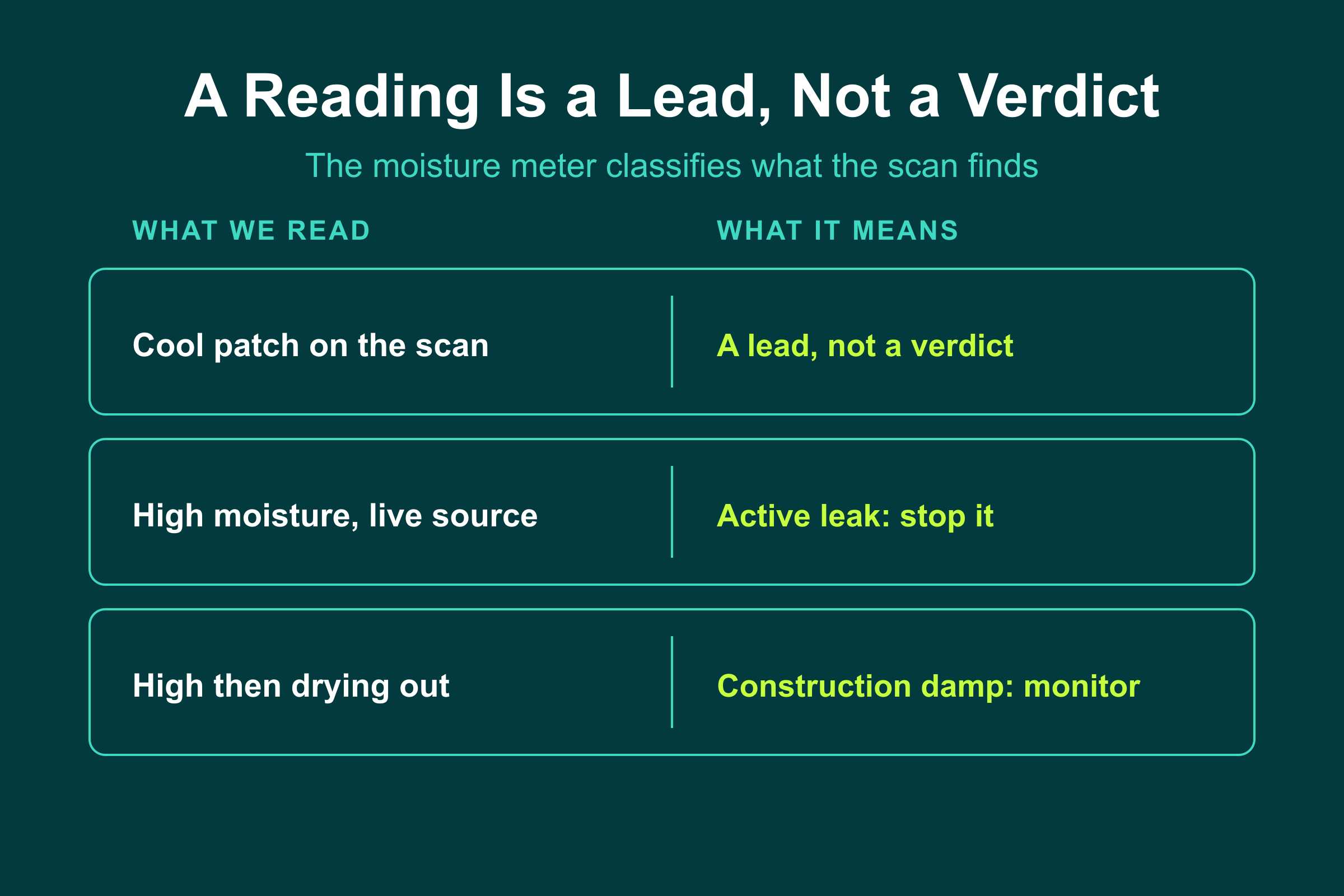
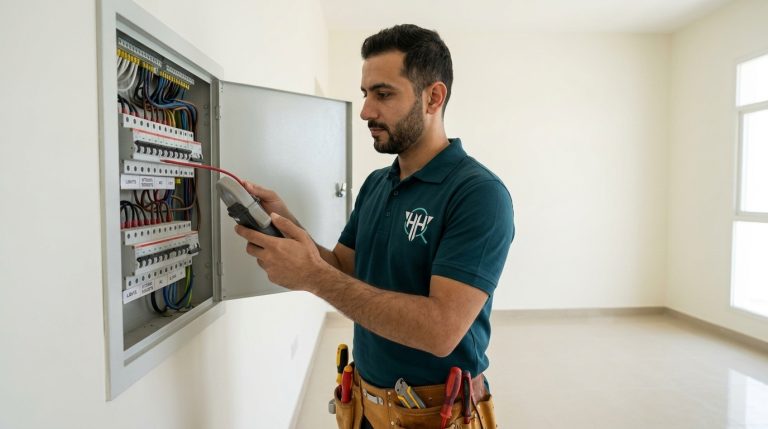
Anything the thermal scan flags gets checked with a moisture meter, which measures moisture content in the material directly through contact probes.
The meter also allows us to classify what we find. An area reading high moisture with an active source behind it behaves differently from an area that got wet during construction and has been drying since. The first requires the leak to be found and stopped. The second may require nothing at all beyond monitoring.
That distinction matters enormously in a defect report. Reporting every damp reading as an active leak damages your credibility with the developer and buries the items that genuinely need urgent attention.
Why the Under-Sink Cabinet Is Worth Opening
If you do one moisture check yourself at a handover viewing, open the cabinet under every sink and basin and look at the base panel beneath the pipework.
That panel is usually a light-coloured board, it sits directly under every connection, and it shows water staining readily. A weeping compression fitting will mark it long before anything appears on a wall or ceiling.
Run the tap for a minute and look again. Feel the panel with the back of your hand.
It costs you two minutes per bathroom and it catches the single most common concealed leak in new properties.
The Case for Doing This Before You Sign
Moisture is the defect where the gap between early and late intervention is widest.
Caught at handover, it is a fitting tightened or a seal redone. The cost to the developer is trivial and the cost to you is nothing.
Caught a year later, the water has been working continuously. Plaster has softened, skirtings have absorbed, and the repair now involves opening up finished surfaces in a home you live in, then making good. And if it has reached the point of visible staining, remediation may include treating microbial growth.
Nothing about the original fault changed. Only the amount of material it damaged on the way to being noticed.
Our Honest Advice
Do not wait for evidence you can see. By the time a property gives you a visual signal of hidden moisture, the useful window for cheap intervention has already closed.
Scan for it while the property is empty, the surfaces are new and somebody else is still responsible under the Real Estate Regulatory Agency (RERA) framework.
Handover Heroes surveys for hidden moisture across the whole property as part of a full snagging, alongside all 13 systems and 500+ checkpoints, with a documented report and video proof within 24 hours. You can estimate the scope and cost with our snagging cost calculator.
WhatsApp +971 58 580 4376 or visit handoverheroes.ae.